10 Best AI RFP Software Tools for RFP Management in 2026
10 best AI-powered RFP software tools for 2026—covering drafting, compliance, risk detection, Go/No-Go analysis, and proposal automation for AEC, government, and SaaS teams.

10 Best AI RFP Softwares for RFP Management in 2026
Introduction
In an era of tight deadlines and fierce competition, responding to Requests for Proposals (RFPs) has become a high-stakes challenge.
This practical guide compares 10 game-changing AI-driven RFP software tools for 2026, helping proposal teams, bid managers, pre-sales engineers, and especially professionals in Architecture, Engineering & Construction (AEC) and IT/SaaS sectors pick the right solution.
AI RFP software in 2026 goes beyond basic document storage it leverages artificial intelligence for drafting answers, searching past proposals, ensuring compliance, and streamlining workflows.
The result is faster responses without sacrificing quality. If you manage complex bids or large proposal volumes, this comparison is for you.
How Can AI Enhance the Proposal Writing Process?
AI assistance can be applied throughout the proposal lifecycle. Here are some of the most impactful use cases where teams are seeing real benefits:
- First-pass draft in minutes: Perhaps the most celebrated use of AI is to generate an initial draft of answers super fast. What used to take hours of writing, AI can do in moments by leveraging past knowledge.
For example, an AI RFP tool can answer a 100-question RFP in a few minutes with content drawn from your library, accomplishing in a flash what might take a proposal team many days. This doesn’t mean the proposal is ready to send but you immediately move to the revision stage with a solid foundation.
- Requirement checklist and compliance matrix: AI can automatically produce a compliance matrix or checklist by cross-referencing the RFP’s requirements with your responses. This use case is huge for government bids or complex technical RFPs.
Instead of manually building a matrix to ensure every “shall” and “must” is accounted for, the AI can list each requirement and indicate where in your proposal it is addressed. This not only saves effort but gives peace of mind that nothing fell through the cracks.
- Executive summary and win themes alignment: AI can even assist with the higher-level sections of your proposal, like the executive summary or cover letter. By analyzing the RFP and perhaps the client’s stated goals, an AI writing assistant can suggest key points to highlight essentially aligning your win themes directly to the client’s pain points as gleaned from the RFP.
For example, if the RFP frequently mentions “on-time delivery” and “safety record,” the AI might recommend emphasizing your company’s 98% on-time track record and safety awards in the executive summary. It ensures that your proposal’s messaging resonates with what the client is asking for.
In all these use cases, the theme is clear: AI handles the grunt work and analysis, freeing your human experts to handle the strategy, creativity, and decision-making. The result is a proposal process that is faster, smarter, and yields a more polished, compliant, and persuasive proposal which is exactly what you need to win in 2026.
Here are 10 Best AI Software Tools for Leading RFP Management in 2026
Now let’s dive into the top AI-powered RFP solutions on the market and see how they stack up. For each tool, we’ll provide a brief overview using a consistent template so you can compare easily. We’ll cover what each is best for, their standout AI capabilities, workflow strengths, any watch-outs (areas they may fall short), and the ideal team profile that would benefit from that tool.
(The list is in no particular order, but we’ve put the one we think is most cutting-edge first. As always, “best” can be subjective it depends on your needs. Use the comparison table after the list for a quick side-by-side summary.)
1) Responsive
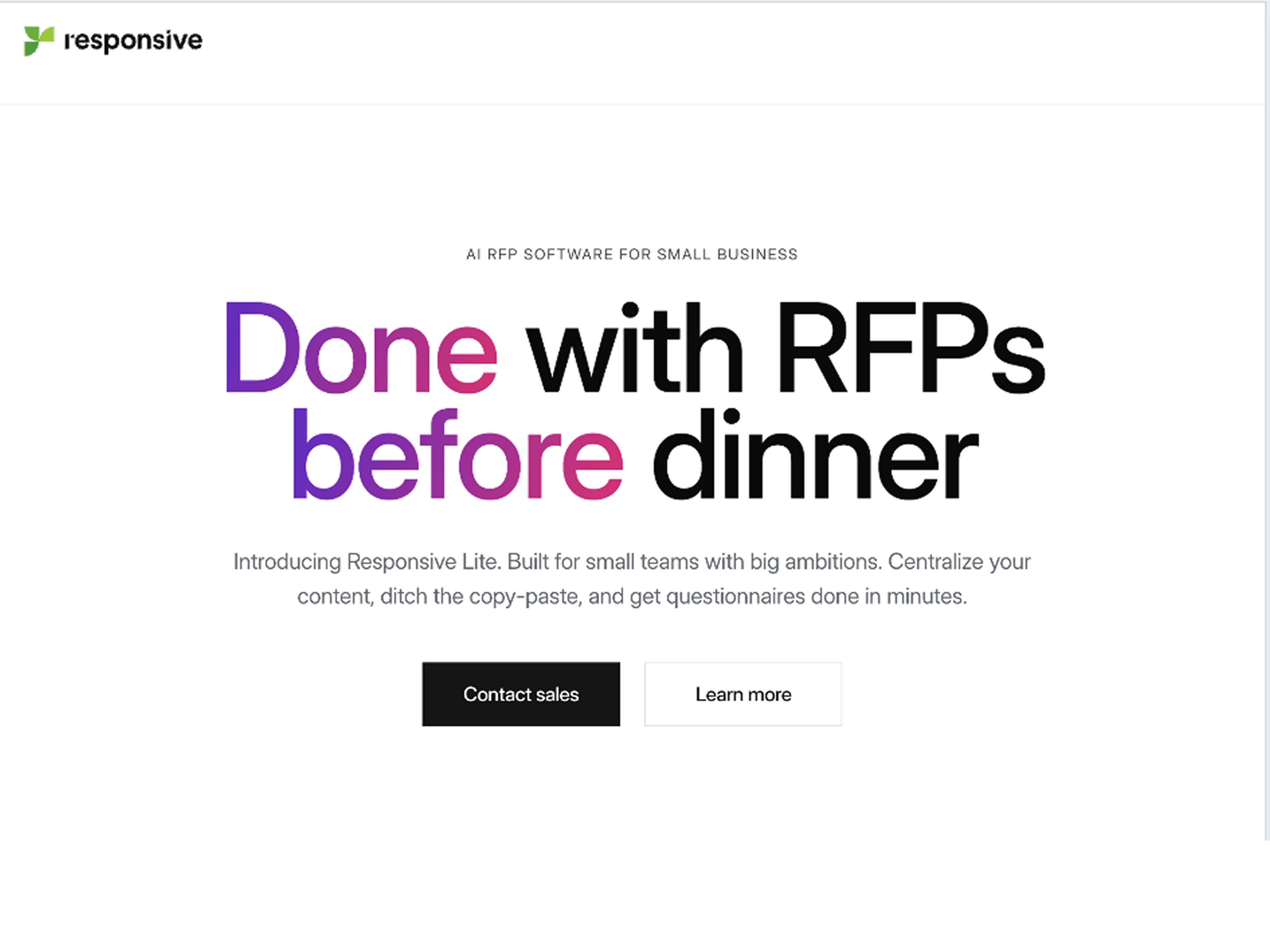
Responsive (formerly known as RFPIO) is known for its robust content library and automation. Its AI Assistant can auto-answer up to 70-80% of questions by pulling from your curated knowledge base, often completing a first draft in minutes.
Responsive also offers AI-driven RFP “shredding”, which means it can parse complex questionnaires or requirement lists and map them to library content. Another neat AI feature is content recommendation and auditing it can suggest the best answer if you have multiple similar entries and identify if any content is outdated or duplicate.
The platform is also starting to integrate generative AI to refine answers for tone and consistency on the fly. In short, Responsive’s AI is geared toward speeding up the answering process while leveraging a large repository of past content.
2) Loopio
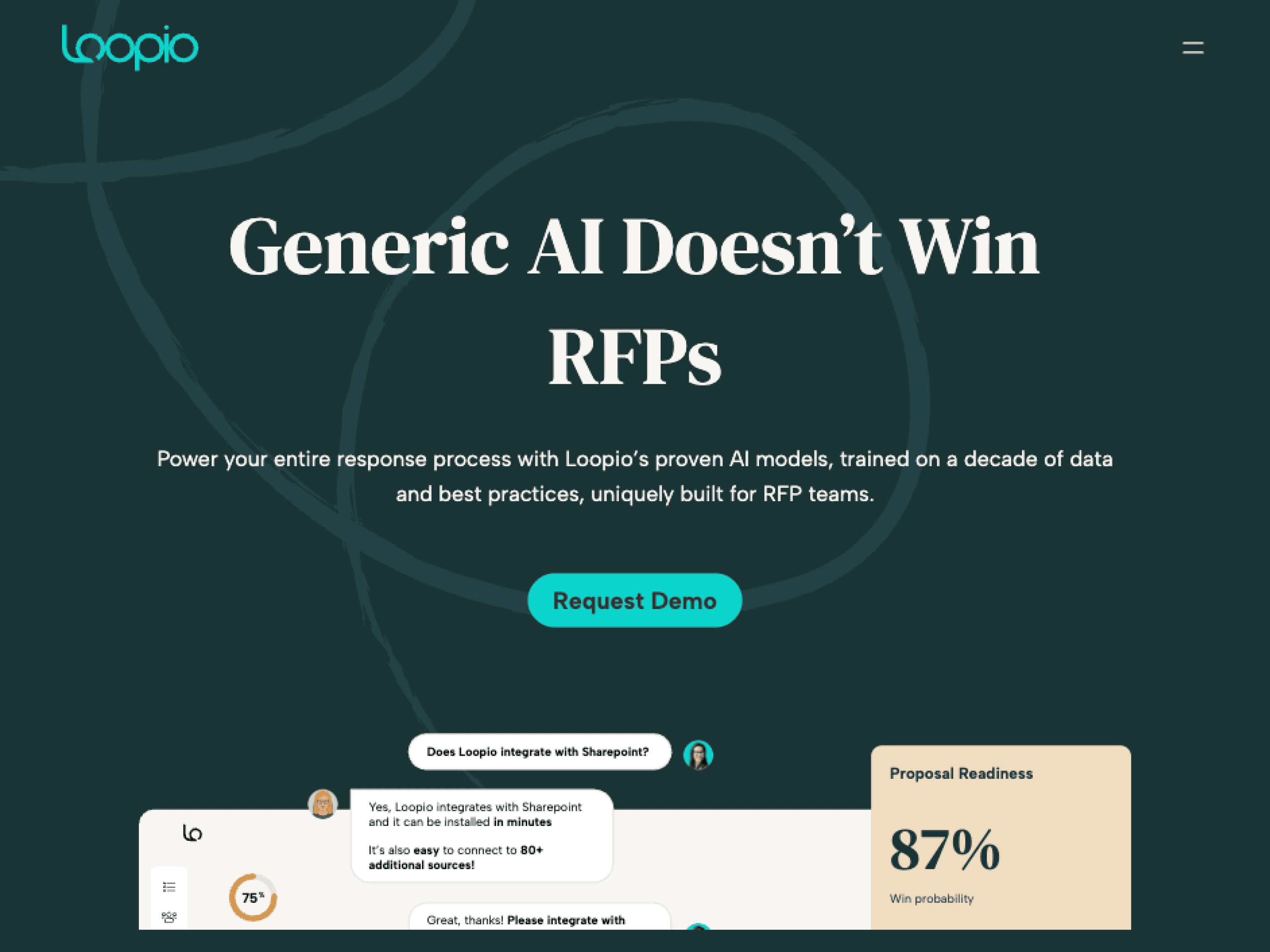
Loopio has long been known for making answering RFPs easier through its content library and automation, and it’s been adding AI capabilities as well.
The core feature is its magic import and auto-fill: you can import an RFP (like a questionnaire spreadsheet or Word doc), and Loopio will auto-suggest answers from your library for each question. Essentially, it uses AI search under the hood to find the best matches.
In 2026, Loopio also offers a new AI writing assistant called Loopio AI that can help improve or rephrase answers and ensure consistency in tone. Loopio’s AI also can identify if content in the library is similar or duplicated and prompt you to consolidate, which keeps the knowledge base clean.
3) ContraVault AI - AI-first RFP analysis + proposal drafting
- Best for: Organizations dealing with highly complex, multi-document RFPs and tenders, especially in construction, engineering, and other project-driven industries.
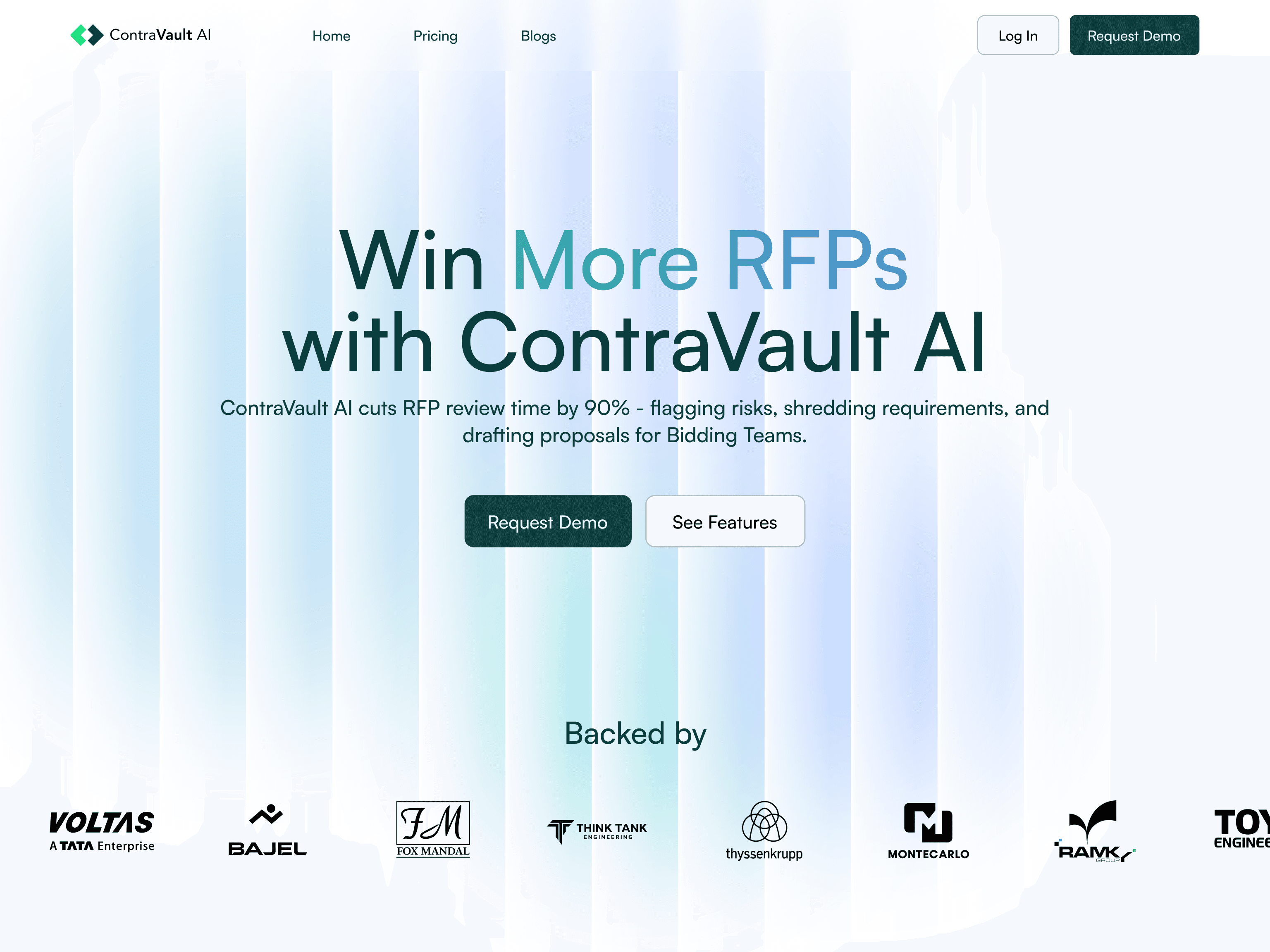
- ContraVault is an AI-first platform built specifically to tackle large, complicated RFP packages. It offers clause-level document analysis the AI reads full RFPs (hundreds of pages, specs, contracts) and automatically extracts requirements, terms, and potential pitfalls.
It has built-in risk detection that flags contradictions or risky clauses across the entire RFP package. ContraVault AI ingests the entire RFP package, normalizing all files and parsing clauses with source tagging. Shred requirements verbatim to build a compliance matrix, detect contradictions/risks, and map each to its origin. Draft the proposal by retrieving best-fit content from the company’s bid knowledgebase, assembling compliant, cited responses end-to-end. ContraVault AI’s Go/No-Go Analyser the AI scores an RFP against your custom criteria to advise whether it’s worth bidding, a huge help when you have more opportunities than bandwidth. Additionally, it supports multi-document search, so you can ask the AI questions across all bid documents and get answers with references, staying compliant and informed.
- Workflow strengths: This tool was built with heavy collaboration in mind. It supports assigning sections to SMEs, tracking progress, and iterative review. It effectively creates a single source of truth for each bid no more emails with different file versions. The interface provides a tender “synopsis” or dashboard that summarizes all key details (deadlines, requirements met, risks flagged) for easy executive review. Integration-wise, ContraVault AI connects with common document repositories and has robust user permission controls (helpful if you involve external partners). It’s also designed to handle multi-year knowledge bases it can ingest tens of thousands of past Q&As and make them instantly searchable for your team.
- Ideal team profile: Architecture, engineering and construction firms, government contractors, and large engineering companies that regularly answer lengthy, detail-heavy RFPs will get the most out of ContraVault.
A proposal team that includes legal, technical writers, and management will appreciate how it brings all contributions together. Mid-to-large enterprises that have a dedicated proposal function (or bid managers) will find this platform fits well.
ContraVault was trained on over 200,000 real RFPs and fine-tuned with input from industry veterans with 30+ years of bidding experience. That domain expertise shows its AI understands construction terminology and procurement nuances out of the box. It’s essentially the “brain” of an experienced bid manager in software form, which helps explain why companies using ContraVault have reportedly been able to cut analysis time by 90% and double their bid win rates (by focusing on the right bids and crafting stronger responses).
4) VisibleThread
VisibleThread is an AI-powered proposal and contract analysis platform focused on clarity, compliance, and risk reduction in RFP responses. Unlike tools that help generate answers, VisibleThread concentrates on improving the quality and defensibility of what you submit.
For RFPs, VisibleThread analyzes solicitation documents and draft responses to identify ambiguous, risky, or non-compliant language. Its natural language processing models flag issues such as unclear requirements, vague terminology, inconsistent phrasing, passive voice, and missing commitments that often lead to evaluator confusion or post-award disputes. It also checks for alignment between the RFP requirements and your draft response, helping teams avoid accidental gaps or misinterpretations.
In practice, VisibleThread acts like a quality-control and risk lens for RFPs helping teams submit clearer, more compliant, and lower-risk proposals, especially in regulated, technical, or high-stakes procurements where precision matters as much as speed.
5) QorusDocs
QorusDocs focuses on proposal generation and content management, with a particular strength in document automation. Its AI features include smart content recommendations as you build a proposal, QorusDocs can suggest relevant content from your library (text, case studies, resumes, etc.) that fits the context.
They have embraced generative AI as well: for example, QorusDocs can use GPT-like capabilities to assemble a first draft of an RFP answer by pulling together pieces from past proposals, or even to create a custom cover letter given a few bullet points.
One claim from QorusDocs is that their AI helps teams answer 5x more RFPs by automating a lot of the heavy lifting.
Overall, QorusDocs’ AI is about speeding up content assembly and ensuring every proposal is populated with the strongest content you have, tailored to the client.
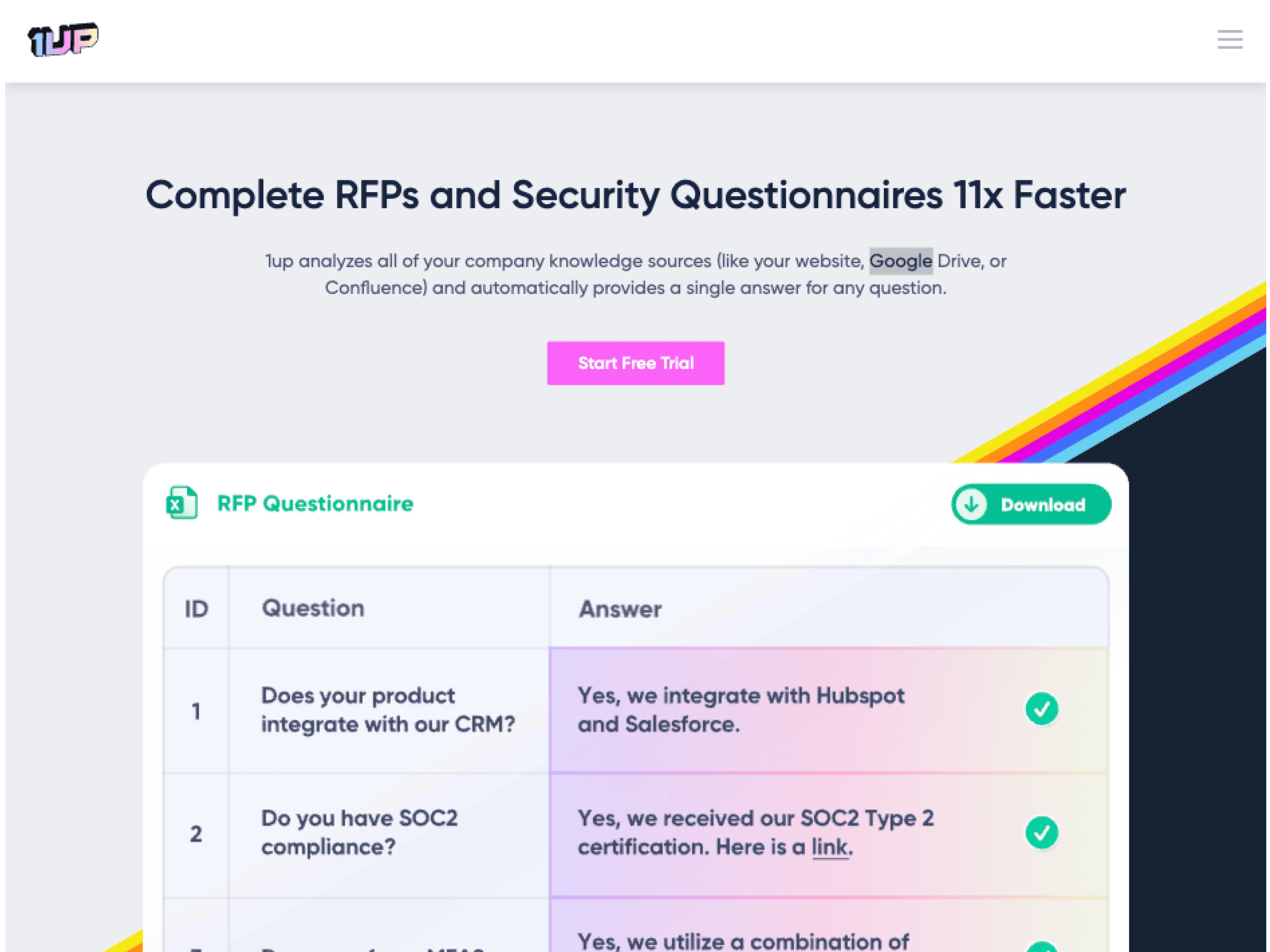
6) 1up
1up is a newer AI RFP tool that prides itself on being the “fastest way to complete RFPs and questionnaires.” Its AI is tuned to generate answers very quickly from your provided reference materials.
A key capability: you upload your sources (past proposals, documents, FAQs) and 1up’s AI will generate hundreds of answers in minutes using the sources you trust . Essentially, it’s focused on speed and quantity great for completing lengthy security questionnaires or RFPs by auto-filling answers.
The AI aims to be accurate by sticking to the content you’ve fed it (hence “sources you trust” mantra). It’s not as sophisticated in risk analysis or doc parsing, but for pure Q&A generation it’s very handy.

7) Inventive AI
Inventive (from Inventive.ai) positions itself as a next-gen RFP tool with strong AI at its core. Its capabilities include highly automated answering (similar to others, it can auto-generate a large portion of answers), but it goes further with quality enhancements.
Inventive’s AI emphasizes understanding context deeply it aims to handle complex questions that might require synthesizing information, not just copying a past answer . The platform touts the ability to boost win rates significantly up to 50% higher win rates by using AI to refine proposal content and target the right opportunities . It also claims to cut response time by 90% with automation, which implies very aggressive time-saving measures.
Inventive incorporates go/no-go decision support using AI, helping teams evaluate RFPs based on historical data and fit (similar to ContraVault’s approach). Additionally, Inventive has AI for compliance checks and red-flag warnings during drafting, ensuring you don’t submit something non-compliant or risky.
8) Joist AI
Joist AI helps in organizing and retrieving institutional knowledge (think past project descriptions, staff resumes, firm qualifications) and using AI to weave that into proposals. Its AI can surface relevant content in seconds – for example, if you’re responding to an RFQ about a hospital project, Joist will pull up similar healthcare projects from your archives to include .
It also employs AI to compare your draft proposal against the RFP requirements, acting as a compliance check. One cool feature: Joist can compare a proposal draft to the original RFP to ensure quality and compliance, highlighting any sections in your draft that don’t fully answer the RFP or where requirements might not be addressed . This is incredibly useful in AEC where missing a single requirement (like a safety plan or a specific past experience detail) can get you eliminated.
Additionally, Joist AI helps maintain a consistent brand voice – it will recommend text or phrasing based on what has worked in past winning proposals, almost like an AI editor that knows your company’s style. It’s not a generic AI; it’s fine-tuned on AEC proposal language, so it understands terms like “LEED certification”, “design-build”, “change orders” etc., which general AI might fumble.
9) OpenAsset’s Shred AI
Shred.ai lives up to its name by “shredding” RFPs – it uses intuitive AI to review an RFP document and extract key details verbatim . Essentially, it digests the RFP and spits out an outline or list of requirements, so you don’t have to manually scour the document.
This ensures your response is compliant because you won’t miss a requirement – everything is laid out for you. Shred.ai also offers real-time compliance checks: as you build your proposal, it can signal if any RFP detail hasn’t been addressed yet .
For example, if the RFP asked for a specific certification and your draft hasn’t mentioned it, Shred will remind you. Another feature is AI Search and AI Chat within your proposal library.
You can ask it to find winning content (say, “find any past answer about LEED Silver certification”) and it will surface in seconds. It’s like a smart librarian for your past proposals. Shred.ai even helps generate a content outline to kickstart your next proposal, based on the RFP structure.
Finally, it has a Go/No-Go analysis tool: Shred can read an RFP and assist in scoring it against your go/no-go criteria, highlighting factors that match your firm’s strengths or potential red flags.

10) Unanet (ProposalAI)
Unanet’s ProposalAI is heavily focused on the federal proposal process. Its AI can perform RFP shredding and compliance matrix generation as a starting point . Essentially, it reads an RFP (particularly government RFPs with sections L and M, etc.) and auto-creates the skeleton of your proposal including all the compliance requirements.
One of the flagship features is automated compliance checks against RFP requirements . As you draft, it constantly checks that every solicitation requirement is addressed somewhere, functioning as an ever-watchful compliance officer. They claim this can reduce proposal development time by 70% simply by ensuring you’re not manually cross-walking requirements.
The AI also helps with proposal strategy: aligning capture data (like capture management info about the customer) with the proposal content. It’s less about fancy generative language and more about ensuring no compliance miss and a quick start on heavy documentation. We should note they also mention the ability to respond to more bids (30% more) due to faster turnaround , implying the tool helps increase volume capacity.
Conclusion
The landscape of RFP response management is rapidly evolving, and AI is becoming indispensable for leading teams. We’ve explored 10 of the best AI RFP software tools heading into 2026 each with its own strengths. The right choice ultimately comes down to workflow fit and your organization’s specific needs.
When making your decision, consider the nature of your RFPs and proposals: Are they highly repetitive or uniquely complex? Do you prioritize speed or thorough compliance? Are you in a niche industry like construction that benefits from domain-trained AI, or do you need a general solution for a broad set of proposal types? The goal is not just to adopt AI for its own sake, but to find a platform that genuinely enhances your team’s efficiency without sacrificing quality.
A smart approach is to shortlist 2-3 tools from this list that seem aligned with your needs, then run a pilot or demo with each. Engage your proposal writers, subject matter experts, and even some executives in the evaluation their feedback on usability and output quality is crucial. Measure things like how much each tool reduces the drafting time, how well it improves answer quality or consistency, and whether it catches errors or compliance points you might otherwise miss. Also, factor in intangible benefits: do the team members feel less stressed and more empowered using the tool?
Remember, technology alone won’t solve everything. It’s also about your process. Whichever tool you choose, invest time in configuring it (e.g., building your content library or training the AI on your data) and training your team on best practices. Many successful companies pair an RFP software rollout with process improvements like establishing clear content governance, a go/no-go policy, and metrics tracking (which the software can often help with).
In the end, the best RFP software is one that fades into the background, letting your team focus on crafting winning messages and strategies. The right AI tool will handle the grind the searching, formatting, checking and give you more time to refine win themes and tailor solutions for your clients. That means faster, more consistent proposals and ultimately higher win rates.
FAQs
Sign Up for more like this
By submitting this form, you agree to our Privacy Policy and consent to receiving updates from ContraVault.
Comments0