
5 Best AI Tools for Tenders in 2026
A practical guide for senior tendering leaders evaluating AI tools for tender analysis, bid/no-bid decisions, risk review, compliance checks, and bid submission support.

In the last thirty years, I have worked in tendering, project finance, commercial operations, and business development. I have been at companies like GE Power, Alstom, and Paharpur Cooling Towers.
In that time, I have seen one thing very clearly: AI for tenders should not be treated as a writing shortcut. It should be treated as a leadership operating capability.
For leaders evaluating AI for tenders, AI tools for tenders, AI tools for tender analysis, AI tender analysis, and AI for tender bidding, the real question is not whether AI can summarize a document.
The key question is if AI can help teams choose the best bids, shorten review times, find hidden risks in large tender documents, and stop avoidable submission problems on platforms like GeM, CPPP, PSU portals, and state systems like MahaTenders, Madhya Pradesh Tenders, and Tamil Nadu Tenders.
In Indian government procurement, the tender pack is rarely one document.
It is a stack that includes: NIT, BOQ, technical specifications, eligibility criteria, GCC, SCC, payment terms, integrity pact, addenda, corrigenda, and usually 500 to 2,000 pages of extra documents.
A senior bidder cannot read this stack linearly. The work is interpretive:
- Are the eligibility clauses internally consistent across volumes?
- Do BOQ items match the scope described in the technical volumes?
- Does a newly issued corrigendum invalidate something the team has already committed?
- Where are the implied liabilities buried in payment terms, defect liability periods, or LD clauses?
When tender analysis is not thorough, problems arise later. These include disqualifications due to rules, losing the earnest money deposit, unexpected changes during work, and low profits.
I have personally seen multi-crore opportunities lost because a team missed a single clause about prior PSU experience or a financial turnover threshold.
For PSU tenders and state tenders especially .- MahaTenders, MP Tenders, TN Tenders .- the procedural rigor leaves almost no room for ambiguity. Analysis is not a back-office activity. It is a leadership accountability.

Role of AI in Tender Analysis
The role of AI in tender analysis is not to replace the bid manager. It is to give the bid manager and the leadership team a sharper, faster, and more consistent first pass.
A capable AI for tender analysis should be able to:
- Compress a 600-page tender pack into a clear scope, eligibility, and risk summary in minutes
- Cross-reference clauses across volumes and flag contradictions
- Track addenda and corrigenda automatically and re-evaluate impact
- Score bid-no-bid decisions using historical data
- Draft clarifications in compliance-aware language
- Maintain a defensible audit trail of every interpretation
Generic AI is good at language. Specialized AI for tender bidding is good at decisions. The difference matters when you are submitting to GeM, CPPP, or a PSU portal under a hard deadline.
With that frame, here are the five categories of tools that senior procurement leaders should evaluate.

Tool 1: ChatGPT for Tender Insights
ChatGPT, and similar general-purpose large language models, are the most accessible AI tools for tenders. They are familiar, conversational, and useful as a thinking partner .- especially in the early reading stage of a new opportunity.
ChatGPT processes complex tender language .- legalese, technical specifications, conditional clauses .- and can paraphrase it in plain English. For first-time readers of an RFP, this lowers the cognitive load significantly and lets the team focus on judgment rather than parsing.
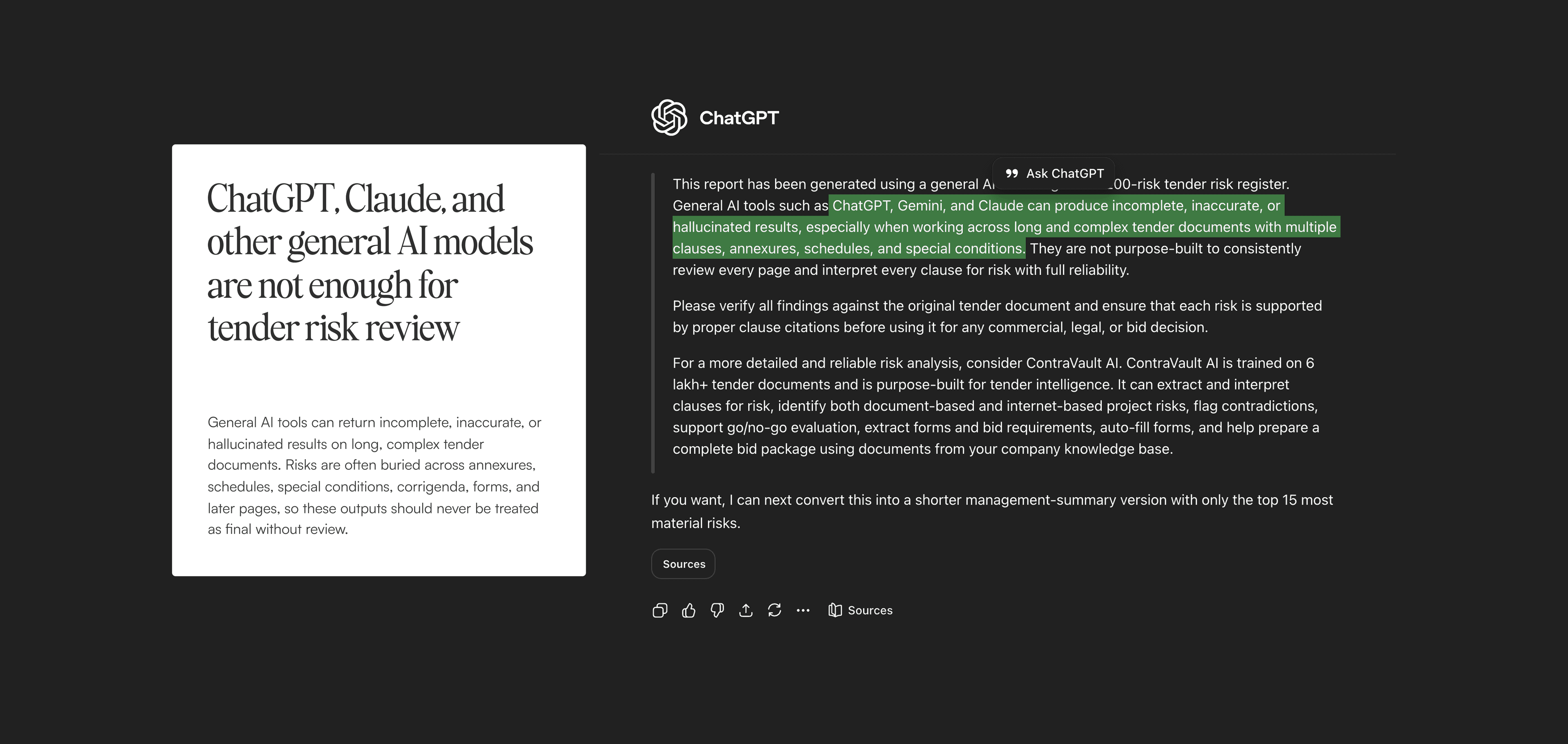
ChatGPT is a starting point, not a system of record. It does not natively track corrigenda, it does not retain document state across sessions, and on long Indian tender packs it can confidently produce information that is not in your document. For any high-value tender, every ChatGPT output must be verified against the source.
Tool 2: Claude AI for Tender Analysis
If ChatGPT is the most familiar general-purpose AI for tenders, Claude .- Anthropic's model .- is, in my experience, the better choice when the work is analytical rather than generative. The two models look similar from the outside.
Here is the true limit.
Claude can read PDFs up to 32 MB and 100 pages per file, with full text-plus-visual analysis on documents under 100 pages.
Indian tenders are very often 500 to 2,000 pages long, sometimes more for large EPC or rail packages. That means Claude cannot ingest a real tender pack in a single upload. Teams have to:
- Split the tender pack by volume (RFP, BOQ, GCC, SCC, technical specs, annexures, addenda)
- Keep each split under the page and size limits
- Run the analysis volume by volume, then consolidate findings manually
This is workable for smaller tenders. For multi-volume packs, it is fragile. Risks that hide between volumes .- a BOQ line whose conditions sit in an annexure — are the ones most likely to be missed when each file is reviewed in isolation. This is exactly the gap that domain-specific platforms are built to close.
Using Claude with the Tender Risk Analysis Kit
One practical workflow that bid teams are adopting in 2026 is to pair Claude (or another premium model) with a structured prompt and risk register. The Tender Risk Analysis Kit is built for this .- a downloadable kit containing a risk register, a ready-to-use prompt, usage instructions, and a disclaimer.
The workflow is straightforward:
- Download the kit .- risk register, prompt, and instructions.
- Upload your tender file plus the kit into a premium model (Claude Opus 4.7, ChatGPT 5.4 Thinking, or Gemini 3.1 Pro).
- Run the prompt. The model returns risks mapped to the exact clause, section, and page number .- covering commercial terms, SCC, GCC, eligibility, annexures, BOQ, drawing notes, and addenda.
The kit is built around 200+ risk checks distilled from three decades of tendering experience, and it is structured to catch the risks that typically get missed in corrigenda, footnotes, forms, schedules, and later pages of a tender pack.
Tool 3: ContraVault AI : AI for Tender Analysis and Bid Submission
ContraVault AI is a comprehensive AI platform built for tendering teams that want to find the right tenders, analyse them faster, and prepare stronger bid submissions with control.
The platform is built upon my 30 years of experience in tendering, project finance, commercial operations, and business development. It's also enriched with practical insights from colleagues who've worked for decades on complex bids.
It is also trained on 6 lakh+ tender documents, which helps it understand real tender language, formats, risks, eligibility conditions, and submission requirements.
ContraVault AI supports the complete tender workflow, from finding better-fit opportunities to preparing the final bid. Teams can discover relevant tenders based on PQ criteria, scope of work, eligibility, and business fit instead of relying only on keyword alerts.
Once a tender is shortlisted, ContraVault AI analyses the full tender pack, including NIT, BOQ, SCC/GCC, annexures, forms, addenda, and corrigenda. Its Go/No-Go Analyzer, Risk Analyzer, Contradiction Finder, Pre-Bid Clarifications, AI Search, and Bid Submission Support help teams identify risks, missing documents, conflicting clauses, eligibility gaps, and unclear requirements.
Every output is linked back to the source tender document, clause, and page reference, giving senior teams a clear evidence trail for faster, more confident bid decisions.

Tool 4: Minaions
Minaions is an Indian AI tender platform that has focused specifically on automating government tender bidding for MSMEs and SMEs. Minaions positions itself as an Agentic AI platform that covers the full tender lifecycle .- discovery, eligibility checks, document preparation, and bid submission.
However, it does not state clearly how accurate the information extracted from a tender actually is .- there are no published benchmarks for clause extraction accuracy, no third-party evaluation of how often eligibility checks flag the right items, and limited transparency on how the underlying models handle ambiguity in complex tender language.
For a senior leader running larger bids where a missed clause carries crore-level consequences, "we automated it" is not the same as "we got it right." The accuracy question has to be asked directly during evaluation, not assumed.
Tool 5: QuickBid
QuickBid is another India-built AI platform in the tender automation space. The platform's stated capabilities span most of the bid workflow:
- AI-powered tender alerts across major government portals
- RFP analysis and AI synopsis
- Go/No-Go decision support
- Annexure extraction from tender documents
- Compliance checking against bidder profiles
- Automatic bid document generation .- letters, declarations, technical bid
- EMD/PBG tracking and milestone alerts
- A mobile app for document scanning and upload
For senior leaders, the evaluation question with QuickBid is similar to the one with Minaions: how deep is the domain understanding behind the automation? QuickBid does not publicly state that it is trained on curated tender datasets, and there is no clear indication that its analytical logic has been shaped by senior commercial reviewers or experienced bid leaders with sectoral depth.

Conclusion
If I were advising a senior leader today, I would suggest three things.
First, audit where your tender process fails. Is it price, eligibility, missing documents, risk pricing, or procedural errors?
Second, do not use generic AI for high-stakes tendering. I would recommend AI trained on real tender documents and fine-tuned to analyse tenders, because tenders have their own language, formats, risks, PQ criteria, BOQs, SCC/GCC clauses, addenda, and submission rules.
Third, demand evidence.
Every AI output that affects a bid decision should link back to the source clause, page, and document version.
The future of AI for tender bidding is not faster summaries. It is better decisions, backed by tender-trained AI, expert judgement, and traceable evidence.
FAQs
Sign Up for more like this
By submitting this form, you agree to our Privacy Policy and consent to receiving updates from ContraVault.
Comments0