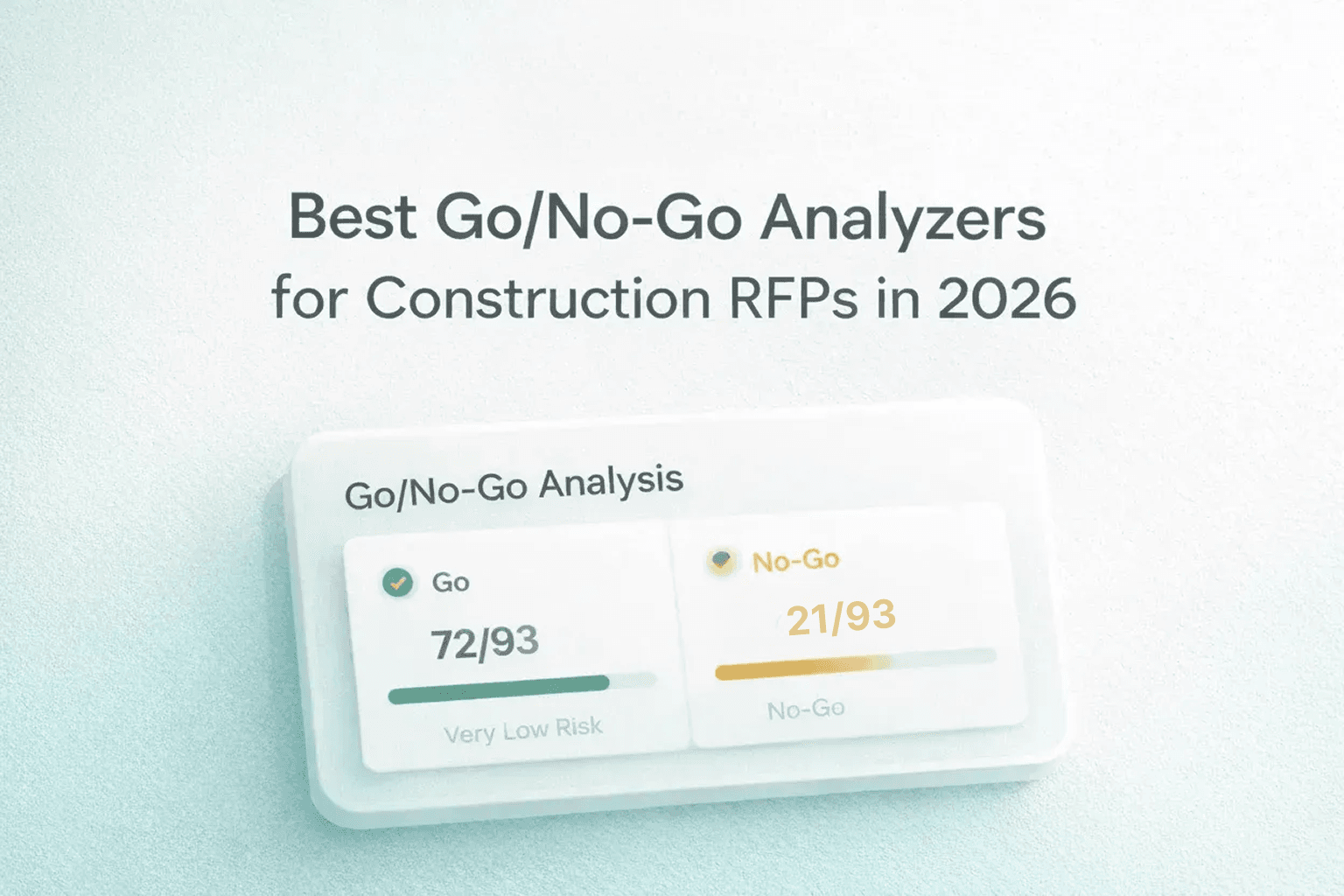
Best Go/No-Go Analyzers for Construction RFPs in 2026
Compare 5 top Go/No-Go tools for construction bidders in 2026—AI RFP shredding, fit scoring, compliance matrices, and risk flagging to help AEC teams qualify faster and avoid bad-fit bids.

Introduction
Every Request for Proposal (RFP) represents both an opportunity and a risk an opportunity to win profitable work, but also a risk of wasting time and resources on unwinnable bids.
This is where a structured Go/No-Go analysis comes in. In this introductory section, we’ll set the stage by explaining why go/no-go decisions are so crucial for construction firms and how modern AI-powered tools (like ContraVault AI) are changing the game.
Go/no-go analysis is essentially the process of deciding whether to pursue a project bid or not based on predefined criteria. It’s not just a gut feeling it’s a data-driven evaluation of how well a potential project aligns with your company’s strengths, resources, and strategic goals. By systematically qualifying each opportunity, construction companies can focus on bidding the right projects and avoid pouring effort into long-shot RFPs that are a poor fit.
In the sections that follow, we’ll dive deeper into the importance and impact of go/no-go analysis in construction RFPs. We’ll break down the key features of an effective go/no-go analyzer and how it ties into things like proposal management, cost-benefit analysis, and project feasibility. We’ll also review 5 of the best Go/No-Go analyzer tools available today.
Best Go/No-Go Analyzers for Construction RFPs in 2026
In architecture, engineering, and construction (AEC), every RFP is an opportunity and a potential drain on resources. A structured go/no-go analysis a data-driven checklist of criteria helps teams decide which bids to pursue. Modern AI tools can now “shred” entire RFP documents in minutes, flagging missing qualifications or onerous clauses and even scoring each opportunity. These tools let your firm focus on projects that fit your strengths and avoid ones that don’t. Smarter go/no-go decisions help AEC teams avoid bad fits, sharpen focus, preserve resources, and ultimately boost win rates. The sections below review five top go/no-go analyzers for construction RFPs, explaining their key features, ideal use cases, and pros/cons.
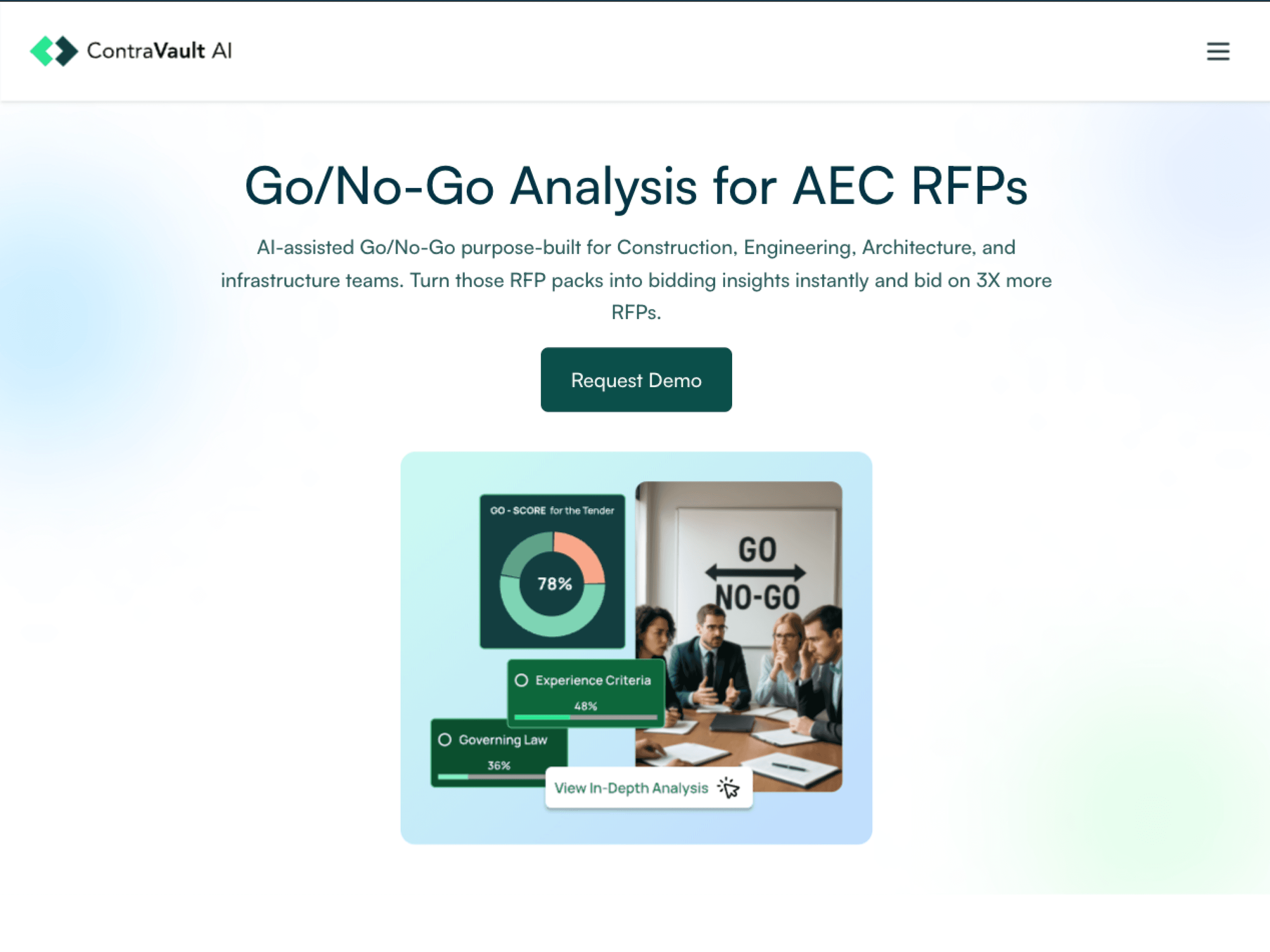
1. ContraVault AI Go/No-Go Analyzer
ContraVault AI is a purpose-built platform for AEC bid management. It can process a 1,000+ page RFP in minutes, automatically scanning the full solicitation package (plans, specs, addenda, contract terms) for any disqualifiers or mandatory criteria. Its Go/No-Go module then assigns a compliance score and rationale, explaining why an opportunity is a good match or not.
For example, ContraVault might flag a missing license or an unrealistically tight schedule and explain that the bid only scores 70% on fit. It also integrates risk analysis calling out hidden pitfalls like strict liquidated damages or impossible deadlines and scoring their severity. In practice, contractors use ContraVault to get a defensible bid/no-bid recommendation in minutes instead of days.
- Key Features:
- AI-Powered Go/No-Go Analyzer: Reads every part of the RFPs to produce a go/no-go score with page-cited reasons, so managers see exactly which requirements are unmet.
- Risk Finder: Detects hidden red flags (unrealistic timelines, liquidated damages, bonding needs, etc.) and rates them by impact.
- Document Shredding & Search: Automatically extracts all requirements (certifications, past project criteria, personnel qualifications) into a traceable compliance matrix. It even offers a context-aware search across all tender docs (specs, addenda, drawings) for quick answers.
- Proposal Drafting: It helps you draft proposals from all the extracted requirements, turning RFP clauses into tailored, compliant sections quickly.
ContraVault is ideal for large contractors or proposal teams handling complex, multi-section RFPs (like public infrastructure or commercial projects). For instance, a general contractor bidding on a federal building can load the entire RFP into ContraVault: the tool will quickly confirm if required bonding and past-project experience match and highlight any deal-breakers. Proposal managers then use the report to make an informed pursue/pass decision or to decide if teaming is needed to cover a gap.
Designed for AEC it’s trained on over 200,000 Construction RFPs so it “speaks the language” of construction RFPs better than generic tools. It delivers a comprehensive analysis (fit, compliance, risk) in one place, turning days of review into minutes. In trials, users saw up to 90% faster RFP response writing. The output is defensible and detailed, giving executives confidence to skip low-fit bids or commit to the right ones. Finally, ContraVault ties into later stages (it can auto-draft clarifications and even proposal text), so no context is lost when you move from go/no-go to proposal.
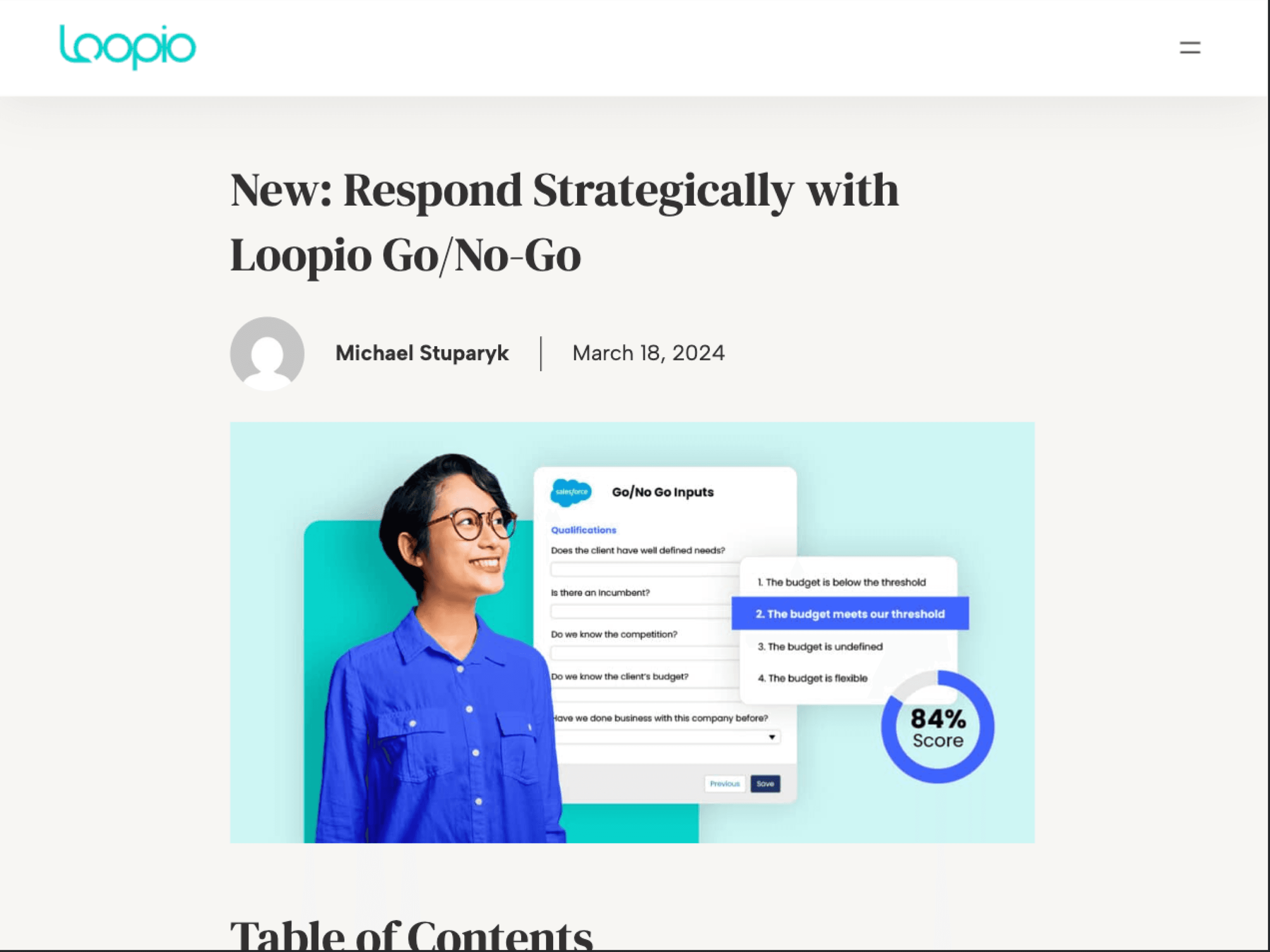
2. Loopio Go/No-Go RFP Qualification in CRM
Loopio’s Go/No-Go feature embeds qualification directly into your sales pipeline (currently via Salesforce). It lets sales or BD reps run a quick evaluation before a proposal team even starts work. Users define a checklist of criteria in Loopio (via Salesforce) for example: Does the project meet size thresholds? Is it in an approved region? Does the team have the necessary certifications? and the system then scores the opportunity in real time. If the score passes a threshold, it can automatically kick off a Loopio RFP project; if not, you can drop it early. Loopio also tracks these scores alongside your win/loss data, helping refine criteria over time.
Loopio Go/No-Go provides a consistent, scalable qualification process for both sales and proposal teams. Because it lives in Salesforce, it’s easy for reps to use and it keeps go/no-go decisions visible at executive level. This leads to more disciplined bidding (resources only go to well-scored deals). It also automatically links with Loopio’s workflow, so a “Go” means you’re ready to start proposal drafting immediately.
Loopio’s go/no-go tool is CRM-dependent (Salesforce only), so you need that platform to use it. Its scoring is only as good as the criteria you define; there’s no deep AI parsing of the RFP text itself. In other words, Loopio helps you evaluate known factors quickly but won’t automatically spot an unexpected clause in a 200-page spec. Companies not on Salesforce/Loopio would have to enter data manually or skip this option.
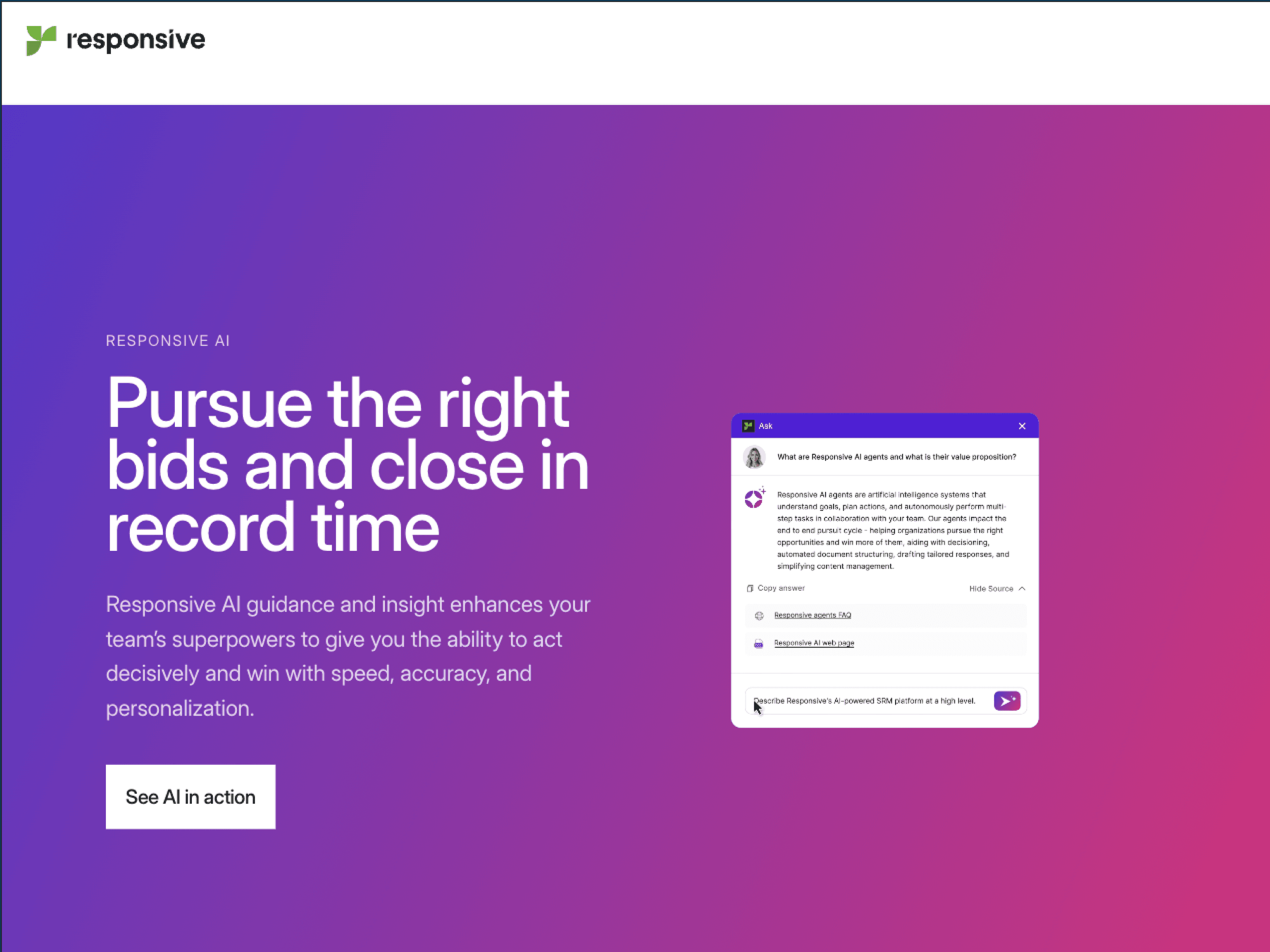
3. Responsive AI AI-Driven RFP Response & Go/No-Go
Responsive (formerly RFP.io) offers an AI-powered RFP response platform with a built-in go/no-go capability. Its AI agents can instantly “shred” any RFP/RFI/RFQ and questionnaire, summarizing the key requirements. One of the advertised benefits is that you can “make go/no-go decisions in a snap” once the AI cuts through the clutter. For example, after uploading a bid request, Responsive will highlight major requirements and generate a high-level summary. The tool’s Trace™ scoring also gives confidence estimates on its answers. All of this frees your team to rapidly identify which proposals are winnable and which should be passed.
Responsive is a broad RFP tool, not specialized for construction, so it may miss some AEC-specific nuances (e.g. local building codes, niche certifications). It’s also a full-fledged SaaS platform, which means implementation and subscription costs. If your RFPs are short or few, the platform’s power might be more than you need. Finally, as with any AI, a degree of human review is still essential to verify the output.
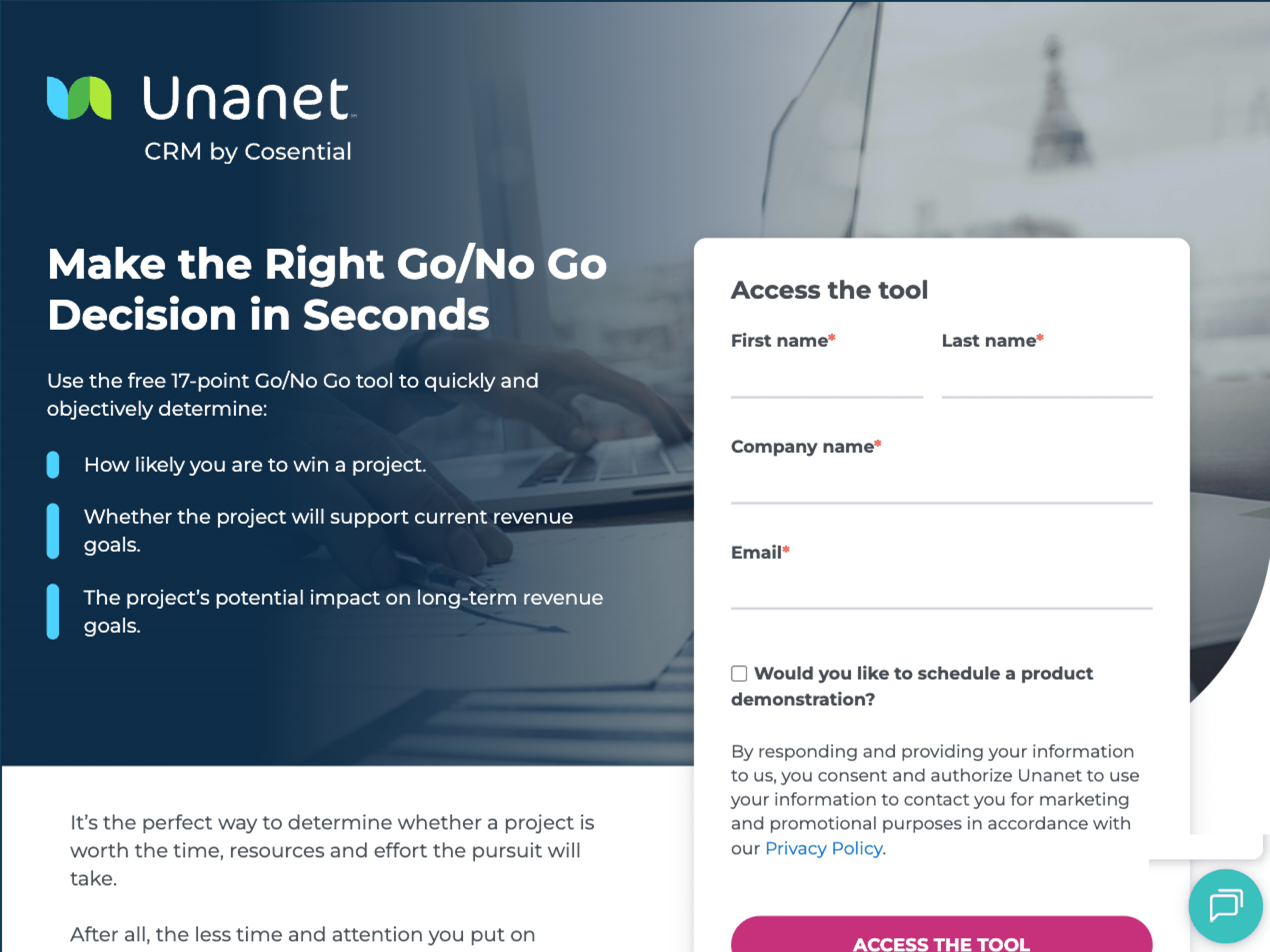
4. Unanet (Cosential) CRM & Go/No-Go Tools
Unanet (via its Cosential CRM) targets AEC and government contracting. For quick project qualification it even offers a free 17-point Go/No-Go assessment tool online. This checklist helps firms “quickly and objectively determine how likely you are to win” a bid based on factors like revenue goals and project fit. More broadly, Unanet’s industry CRM centralizes past performance, teaming options, and customer history so capture teams can see at a glance if a new opportunity fits their portfolio. In short, it replaces gut instinct with data from your own firm and the market.
The 17-point tool is static and manual you have to fill it out yourself and interpret the score. It lacks AI automation of document review. Using Unanet’s CRM for go/no-go means investing in a full pipeline software (which has its own learning curve and cost). Finally, it’s very GovCon-centric, so if you only bid on small private jobs you may not need all its features.
5. QorusDocs AI Proposal Platform (with Go/No-Go Advice)
QorusDocs is an AI-enhanced proposal management platform (often used by professional and technical services firms). While it doesn’t have a dedicated RFP-reading engine, Qorus emphasizes the importance of a formal go/no-go framework. Its thought leadership recommends using a decision-matrix approach: score incoming RFPs by criteria (client fit, competition, deadlines, etc.) to focus on the best opportunities. The platform itself provides content libraries, ROI calculators, and automated proposal assembly once you decide to pursue a bid.
Qorus is not a true RFP analyzer it won’t read the 100-page spec for you. Its go/no-go features amount to general advice and a template (per their blogs), not an automated score. It’s also oriented toward ROI/business-case selling, which may be less relevant on technical construction bids. Large contractors with very detailed spec requirements might find Qorus insufficient for compliance checking they’d still need a tool like ContraVault or manual review for that.
Choosing the Right Go/No-Go Analyzer
No single solution is best for every construction firm. When selecting a go/no-go tool, consider your bidding patterns and needs:
- Bid Volume: If your team evaluates dozens of RFPs frequently, speed is critical. AI-driven tools like Responsive or ContraVault can process high volumes quickly. If you only pursue a few large projects a year, you might prioritize depth of analysis (ContraVault, Unanet) over sheer throughput.
- RFP Type (Public vs. Private): Government tenders often have fixed formats, mandatory forms, and public bid history. Tools like Unanet (with GovCon data) or ContraVault (trained on public-sector RFPs) excel here. For purely private-sector projects, competitive intelligence (like Cliwant-style insights) may be less relevant, and a generic qualification tool could suffice.
- Scope Complexity: Are your RFPs short summaries or 1,000-page technical manuals? For long, complex bids, an AI analyzer (ContraVault, Responsive) ensures nothing is missed. For simpler bids (e.g. a single commercial building Q\&A), a basic checklist or CRM form (Loopio, Unanet free tool) might be enough.
- Geographic/Language Considerations: If you bid internationally, ensure the tool handles different languages and regulations. (Some platforms support multilingual parsing.) For domestic-only work, focus on tools built for your market’s standards.
- Existing Systems: Finally, leverage what you have. If you already use Salesforce and Loopio, their integrated go/no-go add-on is easy to adopt. If you have Cosential or Unanet CRM, their bidding tools slot right in. Always pilot a tool on a real RFP first see if it catches issues you’d have missed and truly saves time.
Conclusion
In the competitive AEC industry, picking the right projects to bid is as crucial as executing them well. A formal go/no-go process supported by modern AI tools ensures you invest effort in the best opportunities. We’ve seen that these tools rapidly analyze entire RFPs, score them against your criteria, and surface hidden risks or missing qualifications. None of them replaces human judgment, but they greatly amplify it. With such analyzers, your teams spend “less time reading and more time winning contracts” , focusing on high-fit bids and improving overall win rates. Whether it’s a fully automated platform or a CRM-based checklist, the result is the same: more confident, data-driven bid/no-bid decisions that save money and boost success in 2026 and beyond.
FAQs
Sign Up for more like this
By submitting this form, you agree to our Privacy Policy and consent to receiving updates from ContraVault.
Comments0