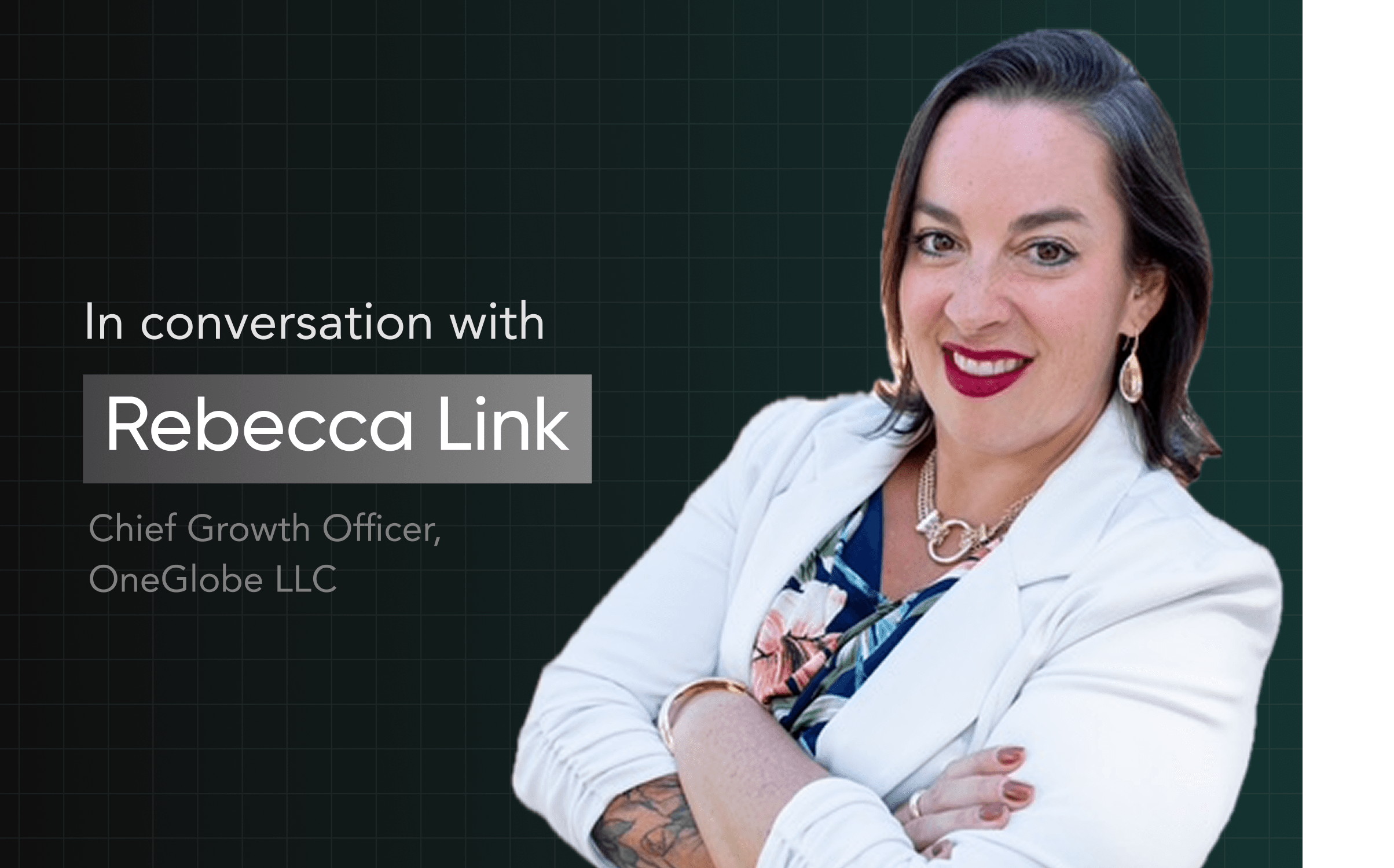
In Conversation With Rebecca Link, VP of Growth at OneGlobe LLC: To Bid or Not to Bid
Rebecca Link on twenty years in federal contracting, what the proposed size standard changes mean for small businesses, and why most AI rollouts fail before they start.

Introduction
Rebecca Link is VP of Growth at OneGlobe LLC, where she runs the Department of Defense and Department of Justice portfolio. She has spent close to twenty years in federal government contracting, moving from technical writing through proposal management and orals coaching into building proposal and growth teams for small businesses.
She joined Maanya on To Bid or Not to Bid for an episode on how federal contracting is changing, and what success looks like in it now. The conversation covered the path into this career, the pressure on small business programs, how AI rollouts go wrong, and what she tells people who are trying to get into the industry.
A Career Built On Writing
Rebecca's background is in writing, including a lot of grant writing, which made proposal writing a natural transition. What kept her was discovering proposal management, a role that fitted being an extrovert, being highly organised and being able to multitask heavily.
The progression she describes is a recognisable one. Start as a writer or proposal coordinator, since writing remains a valuable skill that earns credibility quickly. Move into proposal management. Train as an orals coach if teaching and presenting appeal. Then leadership, building teams and designing process. More recently she has moved into strategic growth and solution roles, which she describes as exciting, very hard, and badly timed against everything changing around it.
She calls herself a human Swiss Army knife, and that breadth is the point. Layoffs, acquisitions, roles that were not a good fit, small companies and large ones, all of it shaped a view of where her skills fit best and what she values in a role.
The Pressure On Small Business Programs
Rebecca has a long-standing preference for working with small businesses, and real respect for people who start their own thing. Government has historically done a reasonable job of making space for them, through small business subcontracting goals on large efforts, Small Business Administration programs, Apex Accelerators, matchmaking events and set-aside designations.
Her view of the current moment is blunter. Specific disadvantaged business categories have been hit harder than others, and the proposed changes to the Federal Acquisition Regulation size standards are, in her words, horrifying. The pitch that companies get to stay in the small business program longer does not reassure her, because changing the size thresholds changes the competitive pool so significantly that it will hurt people, and being held in that category longer is not an attractive prospect for everyone.
Her practical advice was to use the comment period rather than complain afterwards, and to propose something constructive rather than simply objecting. If the change is going to happen, the useful contribution is a version of it that does less damage.
What she likes about small business work is the hustle: wearing many hats, less ego, and the need to be scrappy and opportunistic because nobody knows who you are yet. Large companies start from a brand and a solid foundation. Small ones are constantly building.
Being A Woman In Federal Contracting
Rebecca was candid that this comes up more than she would like, and that it is hard to acknowledge because her instinct is to ask whether this is really still happening.
The paradox she described is specific to this industry. Defence work has historically been male dominated, and proposal management is heavily female, so proposal leaders are often women leading teams that include admirals, generals and people who have been in their roles for decades. Her view is that women have to work noticeably harder to be taken seriously and to receive the same respect that someone else might be given more easily.
Her own approach involves being polite and pleasant while also being firm and taking up space. She described herself on another podcast as a payday bar, sweet and salty at the same time, and one of her company's owners heard it and had a shirt made, which now sits behind her as a reminder. Her broader point about the industry was that if you are not laughing you might be crying, so she tries to bring humour and positivity where she can.
Boundaries, Or The Lack Of Them
Asked how she balances leadership, speaking commitments and team support against burnout, Rebecca answered that she is the wrong person to ask, because her boundaries are poor.
She grew up professionally under the belief that success meant burning yourself out, answering emails at ten at night and picking up work that was not strictly hers. With two young children she carries guilt about being on her phone, and she is clear that this is not a nine to five career.
She gives the younger generation credit for taking work-life balance more seriously, while calling the idea of balance itself a fallacy, since the split is never equal. What has worked for her is smaller boundaries rather than hard ones. Catching up on email during a football practice is fine. Being on the phone through a family dinner is not. The honest version she offered is that she would rather know what is happening than wake up to something on fire.
What Small Contractors Should Be Doing Now
This was the most practical stretch of the conversation, and Rebecca prefaced it by saying she does not want to sound like someone preaching best practice from a distance, because what the industry is dealing with right now is unprecedented.
Her list came down to a few things. Decide which lanes you are swimming in and follow the money, making sure there is enough of your kind of work there. Look at partners who complement and who contrast with your core capabilities. Examine your past performance honestly, because when a small business approaches a large one for teaming, the first question is what you bring to the table, and prime past performance of similar size, scope and complexity is the ongoing difficulty. Recency and relevance matter.
She flagged events as an underrated line item. They cost money, most of them are annual and predictable, and the questions worth answering in advance are how you are budgeting for them across the year, who your targets are, what you hope to get out of each one, and what happens to the information afterwards. It should change an account plan rather than sit in a folder.
The hardest question she posed was about differentiation. Are you swimming in a sea of sameness, saying the same things as everyone else? Her analogy was a row of hot dog vendors, or the deodorant aisle, where the government faces the same wall of near-identical options a shopper does. If you can innovate, meaning build something your technical team can point to and explain in terms of customer benefit, that becomes a genuine strength to write about.
Where AI Rollouts Go Wrong
Rebecca spent several years consulting and teaching on AI in this space, and her criticism of how companies adopt it was the sharpest part of the episode.
Her phrase for the missing step is cleaning for the house cleaner. Before bringing any tool in, a company needs to work out what its data is, then clean, sanitise and structure it. It needs an internal AI policy covering rules and guardrails, written into the employee handbook and reviewed by every employee, because when somebody does something careless you cannot be angry about a boundary you never communicated. She gave an example from that morning: an opportunity under a non-disclosure agreement, with controlled unclassified information, which is not material anyone should be putting into a model, and the question is whether your people know that.
Then comes the work most companies skip. Who is in your growth function, across business development, capture, proposals, writing and solutions. What tasks do you actually want them using AI for. Where does that sit in your own bid process rather than a generic one. Will you structure internal prompts or build custom assistants. And what does success look like, measured how.
The failure she sees follows from skipping that. A company buys a sophisticated platform built for an entire growth team, and a year later finds its people are using two areas of it, while paying considerably more than a handful of general-purpose seats would have cost.
She also defended prompt engineering, knowing some people consider it a passing concern. Her argument is that without a structurally sound prompt you spend your time going back and forth with poor output, and that every model has its own quirks and its own repetitive patterns, which she called AI slop. Recognising those patterns and instructing against them is a skill that takes hands-on practice and getting it wrong a few times.
The last mistake is assuming a customer success team for a month or two is enough, then leaving the workforce alone with the tool and wondering why the results disappointed. She also pointed out that user personas exist at the individual level too. Some people become champions and super users. Others dig their heels in and keep the process they have always had, and motivating them takes time rather than an announcement.
Advice For People Entering The Industry
Her first answer was to run, which she immediately softened.
The serious version starts with a skills audit. What are you naturally good at, are you a strong writer, do you enjoy strategising and problem solving, do you like research. The goal is to find where you will be successful and where you will be happy, which are not always the same place.
Then networking, which she takes seriously enough to describe in practical terms. Clean up your LinkedIn, because when someone hears about you they go and look. Give back publicly, and think about what you want to be known for, since professional reputation shifts over a career. She was the proposal person for years and is now, as she puts it, the AI person in growth.
She also described an exercise she once ran at a conference, handing out paper strips and glue sticks and asking people to build a ladder of where they wanted to climb to, then assign timelines to each rung along with what help or resources each would need. Mentorship, in both directions, came up repeatedly.
To Bid Or Not To Bid
Asked the question the show is named for, Rebecca admitted to wearing rose-coloured glasses more often than not, and framed her answer around a single question: is there a path to yes?
She is not advocating bidding everything that lands in your lap. Sometimes the writing is on the wall, there is not enough time, it is not your customer area, there is not enough of your kind of work, or the internal resources are not there. But if someone on her team has an instinct about an opportunity and wants a little time to pull on some threads, she will give it to them, and often enough they come back having found a route. In the small business world especially, where being opportunistic matters, the partner you met last month can turn a package that looked wrong into one that works.
Her own owner is the opposite, better at poking holes and overturning stones, which she described as a useful balance rather than a disagreement. Good internal decision processes matter either way.
On what success looks like now, her answer was day by day, keep working on yourself, keep your resume and your network current, and look for the thing to be grateful for. She has found her footing again after every difficult period, and while she would not promise that outcome to anyone, resilience and continued learning are what she would bet on.
Sign Up for more like this
By submitting this form, you agree to our Privacy Policy and consent to receiving updates from ContraVault.
Comments0