TxDOT Awarded Contracts: How to Use Award Data to Win More Texas DOT Bids (and When to Walk Away)
TxDOT awarded contracts are the official record of which contractor won a Texas Department of Transportation (TxDOT) letting, at what price, and under what project and district details. For highway, bridge, and heavy civil contractors, this is more than a transparency dataset. It is one of the cleanest ways to calibrate your pricing, understand district competitiveness, and make sharper bid/no-bid decisions before you spend days burning estimating bandwidth.
When most teams say they “track TxDOT awards,” they usually mean they download a list once in a while and glance at the winning contractor name. That approach leaves a lot of value on the table. The advantage comes from using awarded contract and bid tabulation data to answer three recurring questions: what does “competitive” actually mean for this scope in this district, what does the bid spread look like for similar jobs, and which risks keep showing up in projects that look attractive but punish margin during execution.
What you typically learn from TxDOT awarded contract data
Award records and letting dashboards help capture details that directly impact future pursuits:
- Project identifiers and district context to group similar work
- Awarded amount and the engineer’s estimate to understand pricing gravity
- Bidder counts and bid spreads to measure competitiveness
- Repeated winners and patterns in project type, size band, and geography
- Signals that affect execution exposure (schedule intensity, traffic control, phasing complexity)
If you consistently see awards landing at or below the estimate for a particular scope type, that should influence how you build production rates, subcontractor expectations, and contingency assumptions. If another district shows wider spreads and fewer bidders, that may indicate a better fit for your current delivery capacity and backlog strategy.
A repeatable workflow to analyze TxDOT awards
A simple per-letting process becomes a competitive system if you standardize it:
- Bucket awards by district and work type (paving, structures, drainage, ITS, safety)
- Track award versus estimate as a percentage, not just absolute dollars
- Track bidder count and the difference between low and median bids
- Identify repeat awardees and the contract sizes they cluster around
- Document what changed: new entrants, unusual bid compression, scope shifts
- Feed these learnings into your next go/no-go and estimating assumptions
This converts “award tracking” into a forecasting tool instead of a retrospective report.
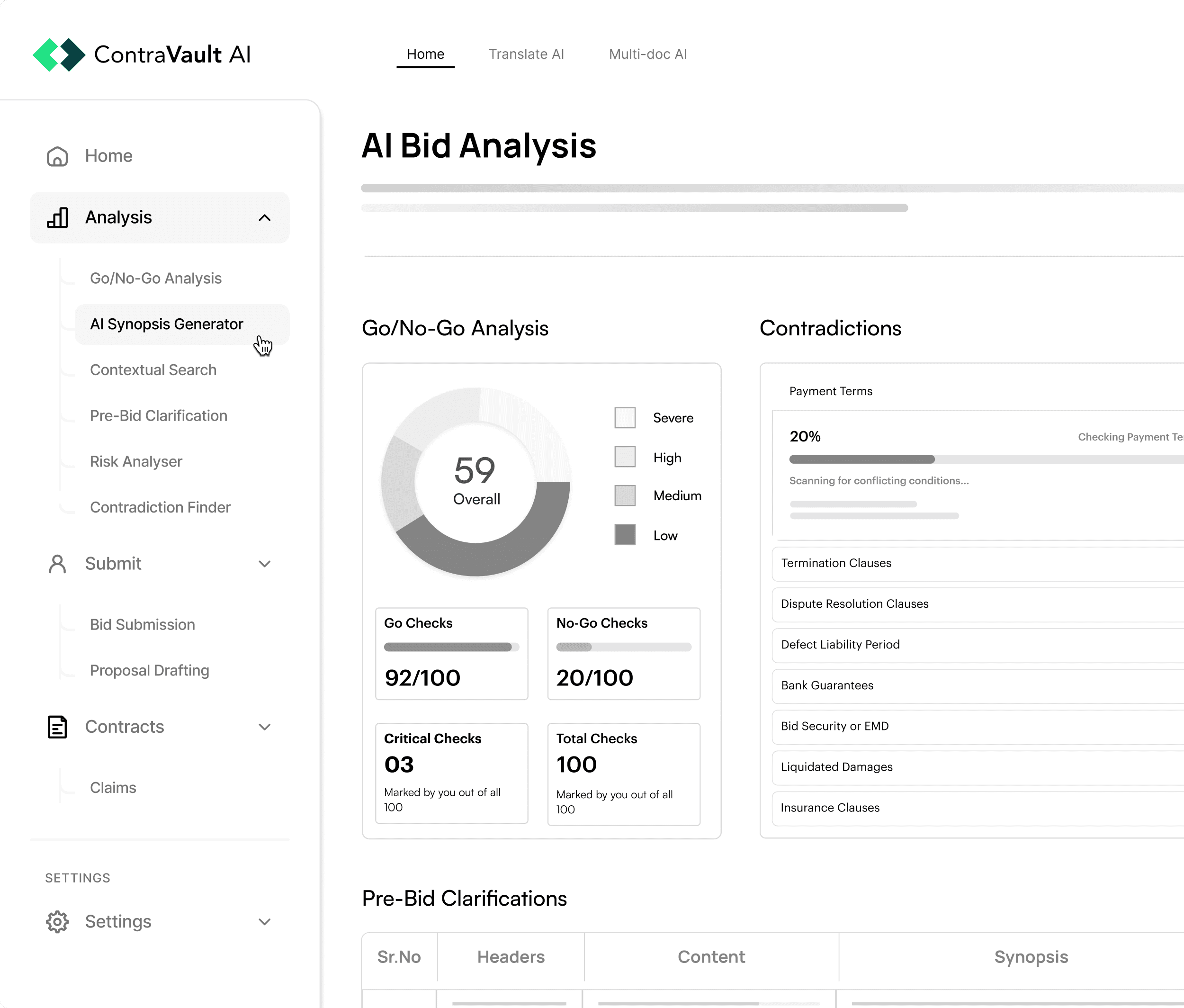
Where the ContraVault AI Go/No-Go Analyzer fits into TxDOT bidding
TxDOT bid packs can be large, multi-document, and time-sensitive. The cost of a poor pursuit decision is huge: wasted estimating time, missed higher-fit opportunities, and avoidable commercial exposure. This is where the ContraVault AI Go/No-Go Analyzer becomes a practical edge for transportation contractors.
Instead of relying on a manual review cycle that drags on for days, bid teams can standardize a go/no-go decision around client fit, delivery capacity, timeline constraints, compliance-critical requirements, and risk exposure. The benefit is not only speed. It is defensibility and consistency. When every pursuit is evaluated with the same decision framework, you reduce gut-feel bidding, protect estimating bandwidth, and improve pursuit discipline across districts and scopes.
The smartest way to use awarded contract intelligence is as an input to this decision. Award history tells you how competitive a district or scope is; the Go/No-Go Analyzer helps you convert that competitiveness reality into a clear recommendation on whether to bid, along with the drivers you must mitigate if you proceed. Over time, your team builds institutional memory: you stop relearning the same lessons every letting cycle and start making faster, more confident calls.
Common mistakes teams make with TxDOT award data
- Looking only at the winner, not the bid spread and estimate variance
- Mixing unlike projects and drawing the wrong pricing conclusions
- Failing to translate awarded insights into bid/no-bid thresholds
- Treating award reviews as reporting instead of a pursuit decision input
- Ignoring recurring execution risks that repeat across similar TxDOT scopes
The contractors who win consistently are rarely the ones who simply work harder. They are the ones who learn faster, systematize decisions, and align pursuits with delivery reality.
Sources
- https://www.contravault.com/features/go-no-go-analyzer
- https://www.txdot.gov/business/resources/lgp/toolkit/process/letting-award/award.html
- https://www.txdot.gov/business/road-bridge-maintenance/contract-letting/bid-tabulations-dashboard.html
- https://www.txdot.gov/business/road-bridge-maintenance/contract-letting.html
- https://www.fhwa.dot.gov