How to Use RACI in RFP Bidding in AEC: A Step-by-Step Guide
Learn how AEC firms can use the RACI matrix to bring clarity, accountability, and speed to RFP bidding—covering Go/No-Go decisions, risk reviews, proposal drafting, and AI-enabled workflows.

Winning construction projects through RFPs (Requests for Proposals) in the Architecture, Engineering, and Construction (AEC) industry is a high-stakes endeavor. Yet, many AEC firms only win about half of the bids they pursue. This means a huge amount of time and effort is often wasted on proposals that don’t pan out. One major reason is the lack of a clear process and role definition when dozens of people are involved in a proposal, things can easily fall through the cracks. In fact, AEC proposals frequently involve large, cross-functional teams; in our survey we found 90% of AEC firms have 10 or more contributors working on each RFP response! In such a complex team effort, confusion over “Who is handling what?” can lead to missed deadlines and costly mistakes.
This is where the RACI matrix comes in. RACI (Responsible, Accountable, Consulted, Informed) is a simple framework that organizes your team and keeps the proposal process on track. It ensures everyone involved in the RFP response is on the same page from beginning to end. In the AEC industry, where proposals often span hundreds of pages and multiple departments (from design and engineering to legal and finance), using a RACI matrix can be a game-changer. It brings clarity to who should do what, eliminates overlap, and prevents the “someone thought someone else was doing it” problem that derails so many bids.

What is a RACI Matrix?
A RACI matrix (also called a RACI chart or responsibility assignment matrix) is a project management tool that defines team roles and responsibilities for each task or deliverable. RACI is an acronym derived from the four key roles it designates:
- Responsible (R): The person or people who do the work to complete the task. They are responsible for action and implementation. There can be multiple R’s for a task, if several team members work together. For example, in an RFP response, a subject matter expert might be Responsible for drafting technical answers, or a salesperson Responsible for tailoring content to the client’s needs.
- Accountable (A): The person ultimately answerable for the task’s success. This is the owner of the work who reviews it and signs off when the task is complete. Every task should have only one Accountable person assigned. In the proposal context, this could be a proposal manager or coordinator who oversees completion. If consulted parties disagree, the Accountable person has the authority to make the final decision. Think of this role as the final checkpoint “the buck stops here.”
- Consulted (C): People who are consulted for input before the task is completed. They are typically experts or stakeholders whose feedback is necessary. Consulted parties are active participants they provide feedback, and there is two-way communication. For an RFP, Consulted roles might include the legal team (for compliance and contract terms), IT or security specialists (for technical questionnaires), or finance staff (for pricing and terms). It’s important to set expectations with Consulted individuals so they know when and what input is needed; this avoids them becoming bottlenecks.
- Informed (I): People who need to be kept informed of progress or decisions, but do not contribute directly to the task. This is one-way communication they’re updated on status or outcomes. In proposals, Informed roles could be executives or department heads who want visibility into the bid’s progress. They don’t provide input to the work itself, but they’re kept in the loop (for example, the VP of Construction might be informed that the bid is ready for final approval).
The purpose of RACI is to establish clear ownership and reduce ambiguity. Especially for something as collaborative as an AEC proposal, a RACI matrix ensures every component from initial bid decision to final submission has someone Responsible and someone Accountable, and that all the right people are being Consulted and Informed along the way. This greatly increases the likelihood that the proposal will be completed on time, completely, and successfully. It also helps ramp up new team members quickly on “who’s who” in the process, since they can see the whole project’s responsibility map at a glance.

Step-by-Step Guide to Implementing RACI in Construction RFPs
Now let’s get practical. How do you actually use RACI in an AEC firm’s RFP bidding process? Below is a step-by-step approach, aligned with each phase of the process and highlighting where RACI assignments make a difference. We’ll also mention how modern tools (including AI-driven solutions) can assist at each step, augmenting the RACI framework for even better efficiency.
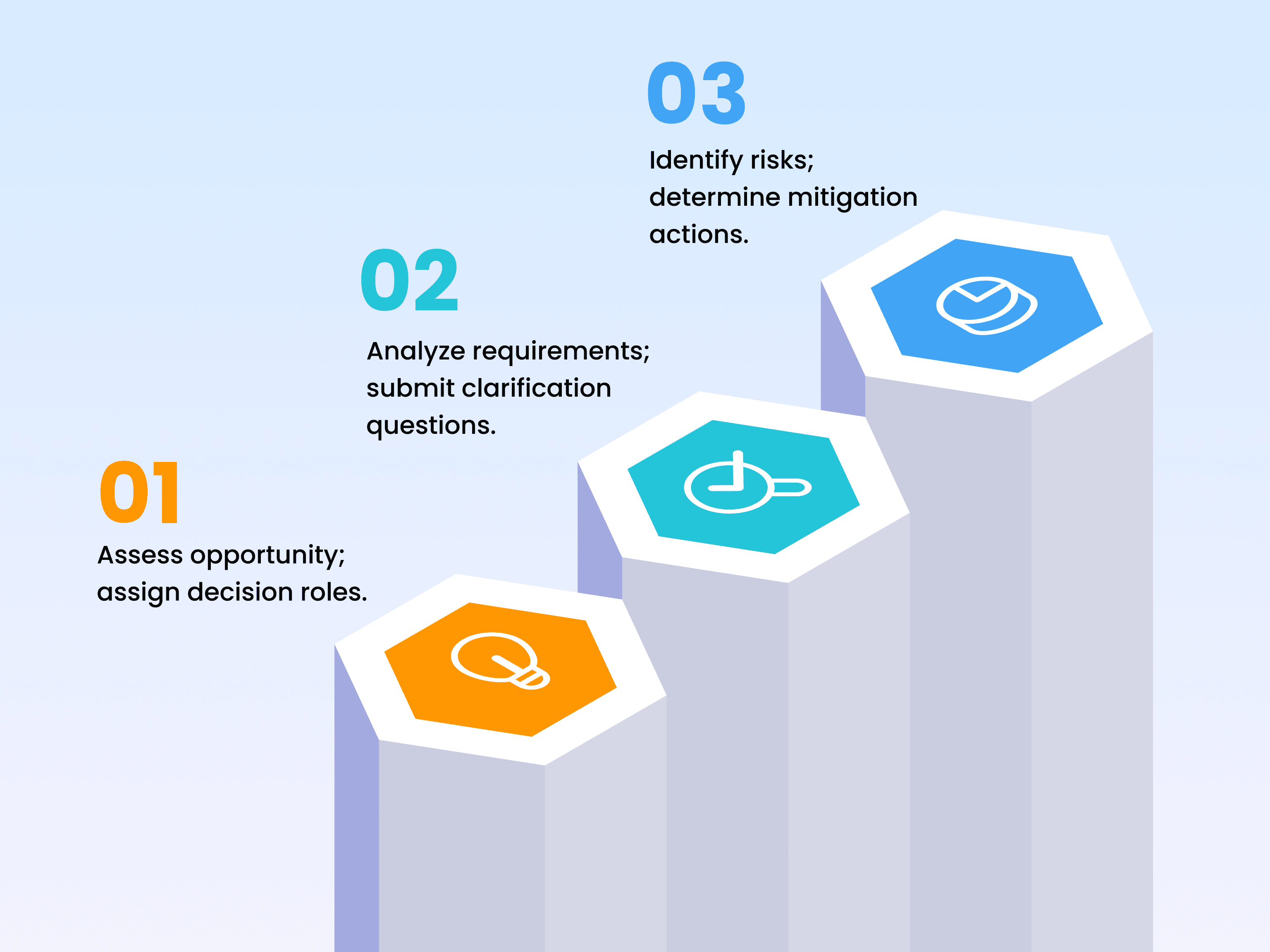
Step 1
Evaluate the Opportunity (Go/No-Go Decision) The first decision is whether to bid on the RFP at all. Assign Responsible (R) and Accountable (A) roles for this critical Go/No-Go analysis. Typically, a Business Development Manager or Proposal Lead is Responsible for gathering information about the project (scope, client, budget, alignment with your firm’s expertise) and presenting a recommendation.
An executive or Principal would be Accountable, making the final “go or no-go” call. Others, like technical directors or finance managers, serve as Consulted (C) providing input on resource availability, risk factors, or past experience with the client. Key stakeholders (like the head of the division) should be Informed (I) of the decision outcome. Using a formal go/no-go matrix with RACI ensures this decision isn’t made on gut feeling alone.
In fact, companies that use data-driven Go/No-Go analyzer have higher proposal win rates. An AI-powered Go/No-Go Analyzer tool can quickly assess the RFP against your firm’s past data and criteria, helping the Responsible person compile facts in minutes.
Step 2
Analyze Requirements and Clarify Doubts (Pre-Bid Clarifications) Once you decide to pursue the RFP, set up your RACI for the RFP analysis and Q&A stage. The proposal manager (or whoever is leading the response) is usually Responsible for dissecting the RFP document identifying all requirements, deadlines, and compliance items. They might create a compliance matrix or summary of key points.
Make someone Accountable for ensuring all requirements are understood and addressed often the same proposal lead or a project manager overseeing the bid. Various team members (technical leads, legal, contracts, etc.) will be Consulted here to flag any unclear areas or concerns in the RFP. For example, the engineering lead might be consulted on technical requirements, the legal counsel on contract clauses, and the safety manager on EHS provisions. They will help pinpoint aspects that need clarification from the client.
Those clarification questions must usually be submitted by a certain date, so one person say, the proposal coordinator should be Responsible for compiling and sending them, with the bid manager Accountable to approve the final list. All relevant team members are Informed of the Q&A responses when the client provides answers. This step is crucial because asking timely questions can resolve ambiguities that, if left unanswered, could hurt your proposal or lead to costly assumptions.
An AI tool for Pre-Bid Clarifications can automatically read the RFP and generate a list of potential questions or ambiguities.
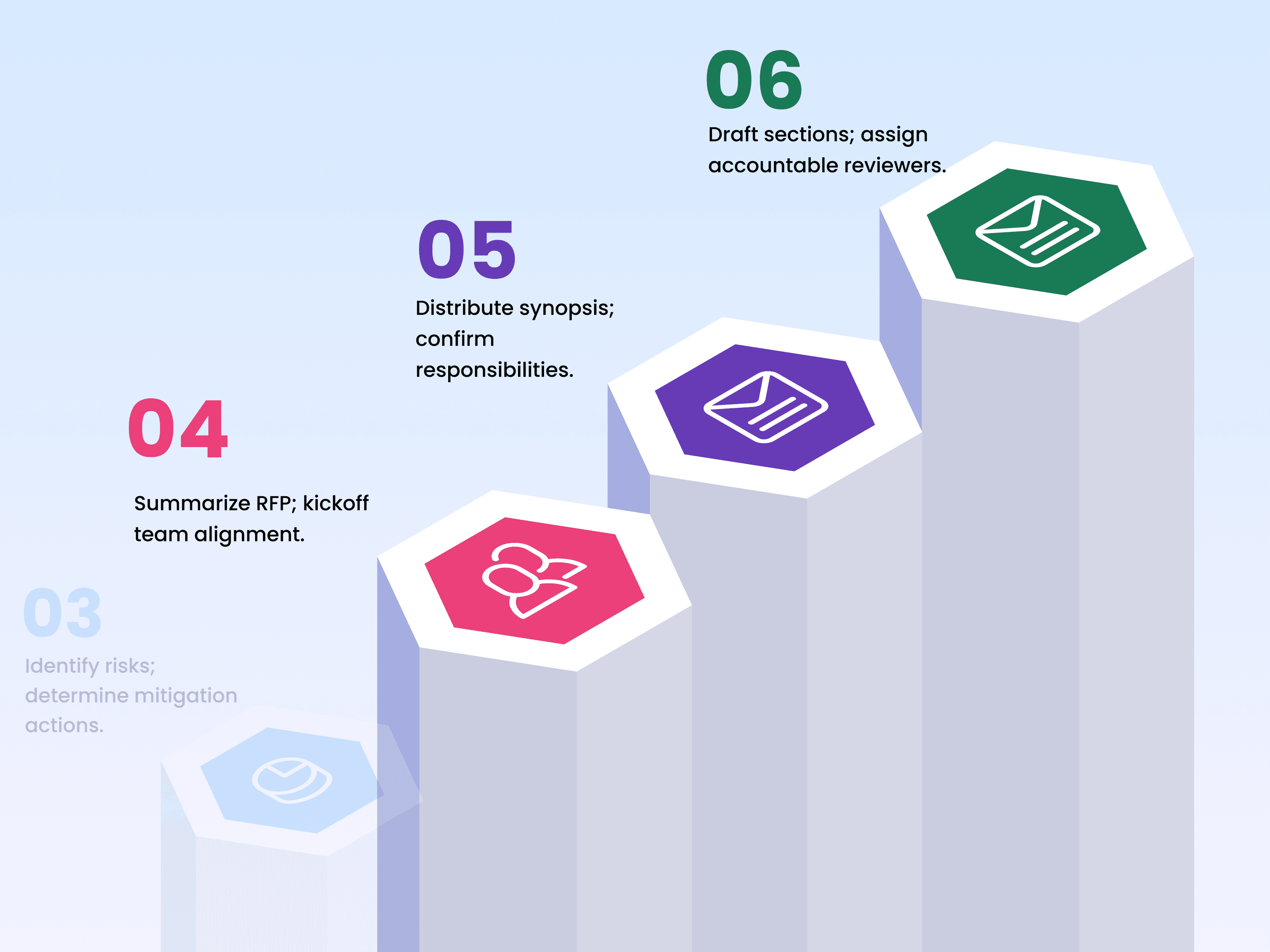
Step 3
Identify Risks and Requirements Early (Risk Assessment) Large construction RFPs often come with complex contract terms and project risks (liquidated damages, strict timelines, unusual warranties, etc.). It’s wise to perform a risk review at an early stage.
Assign a Responsible party for risk assessment this could be a contracts manager, risk manager, or someone from legal or project controls. They will read through the RFP (especially the contract and conditions) to flag any high-risk requirements.
The Accountable person might be an executive or legal head who will decide how to handle those risks (e.g., accept, clarify, mitigate, or if extreme, factor into bid/no-bid).
Consulted individuals could include the project manager for operational risks, the insurance manager for insurance terms, or the safety officer for safety-related requirements.
Keep key leadership Informed about any significant risks identified. RACI ensures that someone is explicitly tasked with looking at risk a step that can save your firm from unpleasant surprises later.
Tip: Leverage an AI Risk Finder tool at this stage. Modern AI can scan through dense contract language to spot troublesome clauses (for example, indemnity clauses, penalty clauses for delays, or onerous insurance requirements).
Step 4
Summarize and Distribute Key Information (RFP Synopsis & Kickoff) At this point, it’s very useful to summarize the RFP for the broader team. In AEC firms, not everyone will read the entire RFP end-to-end, so the proposal manager typically prepares an internal RFP synopsis or kickoff document.
This should outline the project scope, client’s hot buttons, key submission requirements, evaluation criteria, deadlines, and assignment of proposal sections. According to RACI, the proposal manager or marketing lead can be Responsible for creating this summary and organizing a kickoff meeting.
The Accountable person (perhaps the same manager or a more senior sponsor) reviews the summary to ensure it’s accurate and captures everything important. All section authors and team leads should be Consulted to agree on deliverables and schedule (for example, the engineering VP agrees to provide the technical approach by X date, HR agrees to provide resumes, etc.).
The entire proposal team and relevant management are Informed via the kickoff everyone receives the synopsis so they clearly understand the plan. Having this centralized summary reduces miscommunication and aligns the team from the start.
Tip: Preparing such a synopsis can be labor-intensive, but AI can help here too. An AI RFP Synopsis tool can “read” the lengthy RFP documents for you and generate a concise overview with actionable points.
Step 5
Leverage Knowledge and Past Content (Bid Knowledgebase) Writing a winning proposal isn’t just about what’s in the RFP; it’s also about leveraging your firm’s past experience and knowledge. At this stage, different team members will start drafting their sections. It’s extremely helpful to have a repository of past proposals, boilerplate content, templates, and project case studies to draw from.
Responsible roles: Each section leader (like the person responsible for the technical approach, or safety plan, etc.) should search for relevant existing content to avoid reinventing the wheel.
Accountable: The proposal manager or content lead is accountable to ensure everyone has access to the latest approved information (e.g. the latest safety statistics, resumes, project descriptions).
Consulted: If your firm has a knowledge manager or librarian, they could be consulted to help find information. IT can also be consulted if any special data retrieval is needed.
Informed: All writers are informed about where to find and how to use the content library.
Instead of manually digging through folders or old documents, you can use a Bid Knowledgebase tool. This tool lets you store precise answers, resumes and certifications from your company’s past bids.
Step 6
Draft the Proposal Content (Writing and Development) Now comes the heavy lifting: writing the proposal. Each section or task identified in your RFP outline needs to be completed.
Here’s where your RACI matrix really guides day-to-day work: assign Responsible individuals or teams for every major section or task. For example, the structural engineer is Responsible for the technical design approach, the scheduler is Responsible for the project timeline, the marketing writer is Responsible for the executive summary, and so on.
There must be an Accountable owner who oversees the entire proposal content usually the proposal manager but you can also assign Accountables for subsections (e.g., the engineering manager could be Accountable for all technical content, the CFO Accountable for the pricing volume). These Accountable folks review and approve the drafts in their area.
Identify who must be Consulted for each section: the Responsible writer should get input from relevant SMEs (for instance, consult the safety officer for the safety plan section, or consult HR for staffing/ resume details). Also consult past project managers for references or any data needed.
Informed parties at this stage might include executives who want periodic progress updates or need to approve certain content (they might not review every word, but they should be aware of the messaging).
The benefit of RACI here is that at any point, you can look at the matrix and know who to chase for a draft or who has final say on wording. It prevents the scenario of an important section (say the quality control plan) being unowned because everyone thought someone else was writing it.
Leverage writing assistants to accelerate this work. An AI Proposal Drafter tool can generate initial drafts or outlines for sections using the shredded information from the RFP using AI RFP Shredder and your own content library.
AI RFP tools can save tremendous time by producing a solid first draft in minutes, which the Responsible human expert can then refine. In fact, average proposal writing time can be reduced by 90%.
Remember though, Accountable humans in the Bid Team must review AI-generated text carefully the AI can handle rote drafting, but your experts ensure the content is accurate, tailored, and compelling for the client.
Conclusion
Using RACI in RFP bidding for AEC creates a step-by-step roadmap for your team to follow, so nothing is left to chance. It fosters a culture of clarity and accountability that can be felt in the quality of your proposals. When combined with modern RFP strategies like being selective about pursuits, reusing great content, and applying AI-driven analytics it positions your firm to not only submit proposals more efficiently but also win more of the right projects.
The next time your firm tackles a complex construction RFP, try laying out a RACI matrix at kickoff. You’ll likely find that the investment in planning pays off with a smoother process and a more compelling proposal. In an industry where winning just one big proposal can translate into years of work and revenue, improving your RFP win rate by even a few percentage points is huge. RACI and the latest proposal tools are your keys to unlocking that improvement. Now is the time to bring these best practices into your AEC proposal strategy your team and your bottom line will thank you for it.
FAQs
Sign Up for more like this
By submitting this form, you agree to our Privacy Policy and consent to receiving updates from ContraVault.
Comments0