5 Essential Types of Construction Claims You Need to Know
Learn the 5 most common construction claim types—defect, delay, breach of contract, mechanic’s lien, and personal injury—plus how modern AI claim management tools help teams organize evidence, reduce context switching, and respond faster.

Construction projects run on tight schedules, layered contracts, and dozens of stakeholders working in parallel. When something shifts scope, time, safety, quality, payment claims appear. And in most organizations, claims don’t come one at a time. They arrive as a mix of issues spread across the same RFP package, contract clauses, drawings, emails, site instructions, and meeting minutes. Not only can this derail a project’s timeline, it often leads to costly disputes: in North America, the average construction dispute is valued at $43 million and takes about 14.4 months to resolve.
That’s why understanding claim types matters. When you can quickly identify what kind of claim you’re dealing with, you can route it to the right team, preserve the right records, and choose the appropriate dispute path (negotiation, arbitration, litigation) before the situation escalates. In this guide, we’ll cover five essential construction claim types you’ll see across EPC, infrastructure, and general contracting projects plus the common dispute-resolution methods used to close them.
Importance of Understanding Claim Types
In construction, a “claim” is a formal assertion that one party is entitled to relief under a contract or law typically time, money, or both. Knowing the claim type helps you:
- Classify the issue correctly: Determine if it’s a delay, a breach, a defect, a lien, or an injury-related claim.
- Involve the right stakeholders early: Bring in contracts/commercial experts, project controls, legal counsel, safety officers, or QA/QC teams as needed.
- Reduce miscommunication: Use the proper terminology so all parties understand the nature of the issue and their obligations, avoiding disputes caused by misunderstanding.
- Communicate clearly with project partners: Whether it’s the client/owner, subcontractors, or consultants, you can frame the conversation in terms they expect (e.g. discussing delay vs. defect issues).
- Prevent claim stacking: Keep one event from mushrooming into five separate disputes by addressing the root cause under the correct claim category.
Most importantly, claim types define how you should talk about the problem. The framing changes the narrative, the evidence you need, and the legal or contractual remedies available. For example, treating a schedule slip as a breach of contract versus a schedule delay will lead to very different approaches and outcomes.
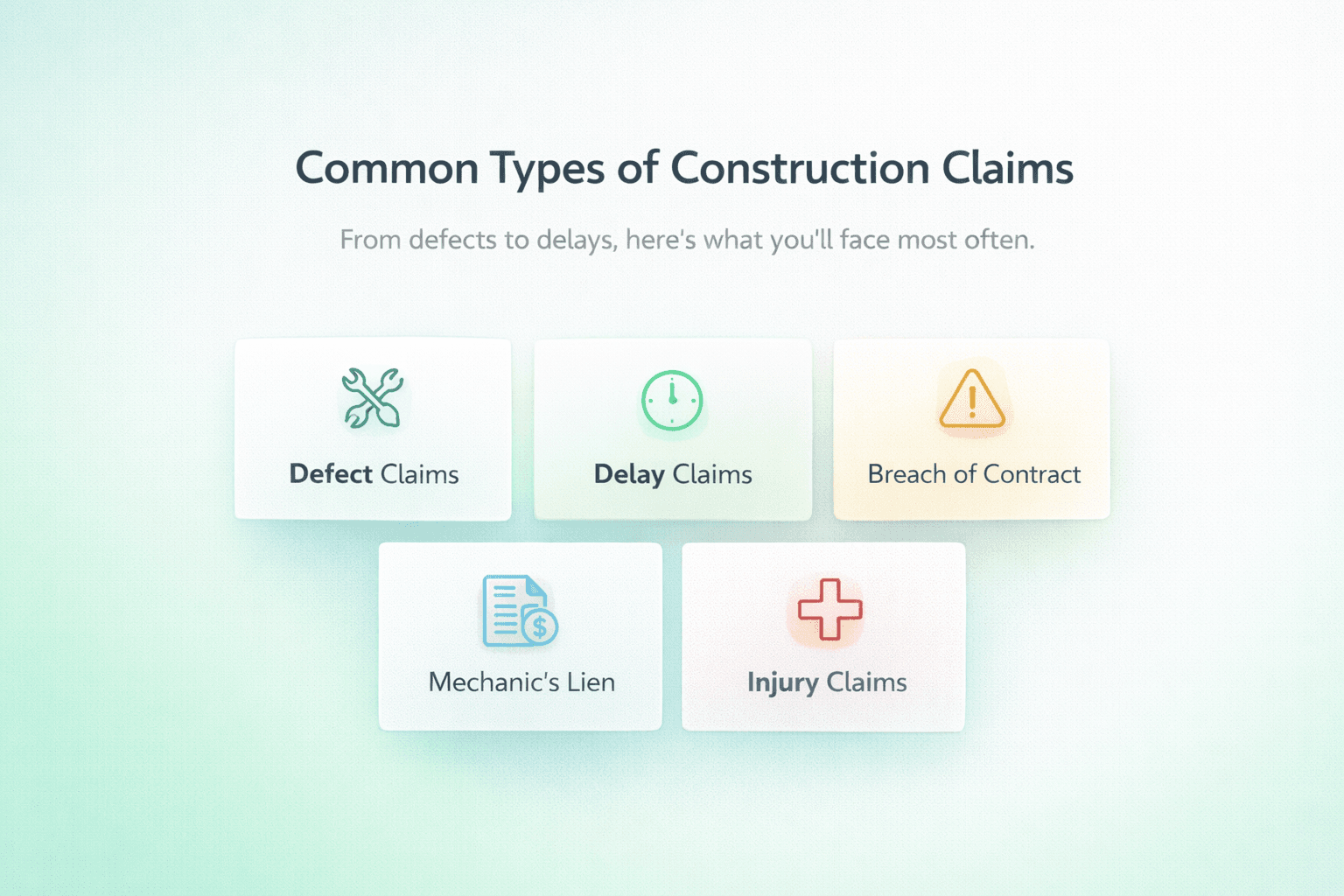
Common Types of Construction Claims
Below are five claim categories that frequently show up in U.S. construction and infrastructure projects. For each, we’ll cover a simple definition (with practical examples) and note why it matters. Understanding these will help you classify issues correctly when they arise.
1. Construction Defect Claims
A construction defect claim alleges that some aspect of the work is defective, non-compliant, or fails to meet the required standard of quality (as defined by the contract, building codes, or industry practice). In plain terms, there’s a gap between the required quality and the delivered quality. For example, a defect claim might involve:
- Structural issues: Concrete cracks beyond allowable tolerances or inadequate structural connections.
- Fire safety non-compliance: Improper installation of fire-rated assemblies or missing firestopping.
- Finish and workmanship issues: Finishes not matching the specification or approved mockups (e.g. flooring, paint, millwork).
These examples illustrate defects ranging from obvious (cracks, leaks) to subtle (subpar performance). Generally, a construction defect is any deficiency in the design, materials, or workmanship that causes part of the project to fall short of reasonable standards or the contract requirements
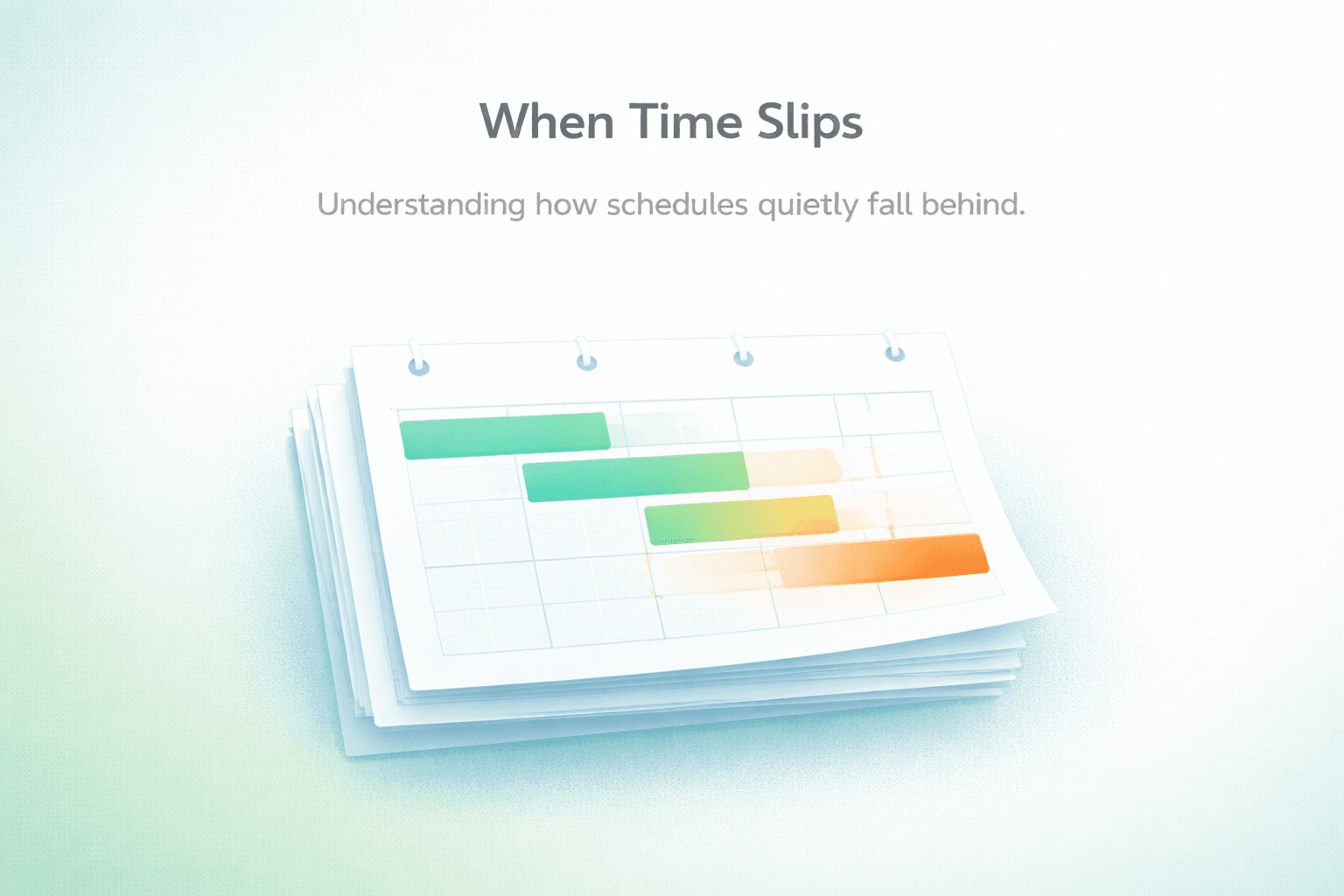
2. Delay Claims
A delay claim often involves proving how schedule setbacks occurred and who is responsible.
Excusable vs. Non-Excusable Delays: A delay claim seeks a time extension, compensation, or both due to events that impact the project schedule. Not all delays are created equal. Contracts typically categorize delays as:
- Excusable Delays: These are delays beyond the contractor’s control, such as unusually severe weather, labor strikes, unforeseen site conditions, or owner-caused changes.
- Non-Excusable Delays: These are delays within the contractor’s control or that the contractor could have reasonably prevented. Classic examples include poor project management, or late ordering of materials without justification.
3. Breach of Contract Claims
According to legal definitions, a breach of contract claim arises when one party fails to fulfill their obligations under a legally binding agreement. Essentially, one side didn’t do what they agreed to do, and the other side is holding them accountable for it.
Common Causes: In a construction context, breach claims often come into play when the issue can’t be neatly categorized as a delay or quality problem, but rather a direct violation of the contract terms. Common breach allegations include:
- Failure to pay amounts due (e.g. an owner not paying a certified progress payment, or a contractor not paying a subcontractor).
- Wrongful contract termination or suspension (e.g. an owner terminating a contract without proper cause, or a contractor walking off the job improperly).
What sets breach claims apart is that they reference a specific contract clause or duty that was allegedly violated. For instance, if the contract says the owner must provide access to 100% of the site by July 1 and they don’t, that’s a straightforward breach of contract by the owner.
4. Mechanic’s Lien Claims
A mechanic’s lien is a powerful payment claim unique to construction. In simple terms, it’s a legal claim against a property, filed by a contractor, subcontractor, or supplier who hasn’t been paid for their work. Think of it as a hold on the property – a way to encumber the project so that the unpaid party has security and leverage to get paid. In many states, it’s also called a construction lien or materialman’s lien. By filing a lien, the claimant (unpaid party) can ultimately force a sale of the property to recoup payment, if things go that far.
For example, if a subcontractor finishes their work but doesn’t get paid, they can file a mechanic’s lien against the project’s real estate. This lien, once recorded, attaches to the property title – meaning the owner usually cannot sell or refinance the property until the lien is resolved (either paid or discharged) . It’s a statutory remedy to ensure people get paid for improving real property.
5. Personal Injury Claims
A personal injury claim in construction is when someone seeks compensation for an injury, illness, or even death that occurred on (or was caused by) the construction project. Construction sites are dangerous, and despite safety plans, accidents happen. Common scenarios that lead to injury claims include injuries from malfunctioning equipment, vehicle accidents on site, fires or explosions, or long-term illness from exposure to hazardous substances (like asbestos or silica dust).
In the U.S., workplace injuries for construction workers often fall under workers’ compensation insurance, which provides no-fault coverage (meaning the injured worker gets benefits without needing to prove the employer was negligent, but in exchange generally can’t sue their employer).
The RFP Reality: Multiple Claim Types in the Same Package – Same Team, Constant Context Switching
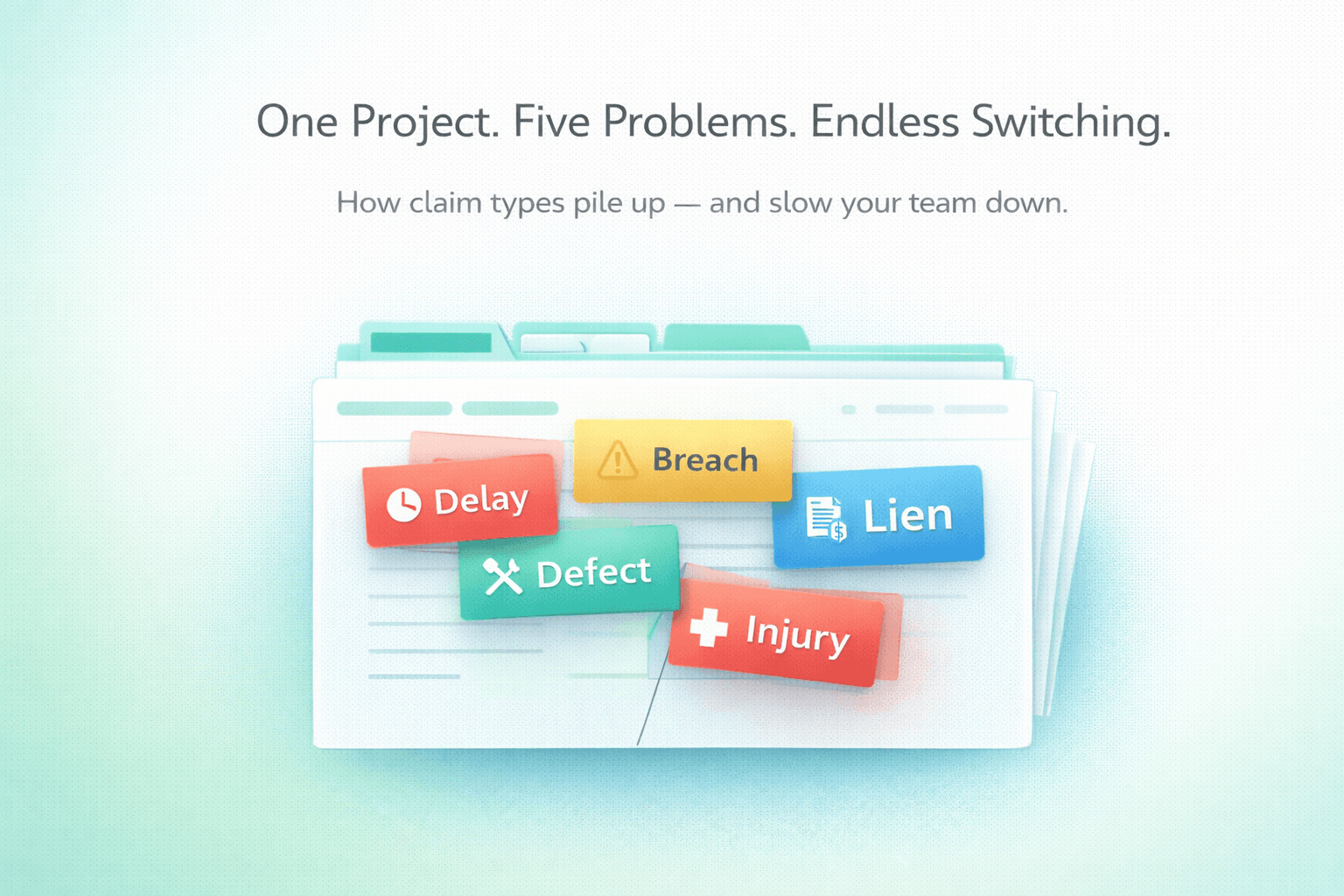
Within the same project, or even the same dispute letter, you could be juggling:
- Delay issues (e.g. an argument over excusable delays, milestone extensions, or liquidated damages for late completion).
- Defect issues (e.g. the owner complaining about quality and threatening a back-charge or warranty claim).
- Breach triggers (e.g. notices of default citing contract clauses, or threats of termination over perceived non-performance).
- Payment security problems (e.g. subcontractors filing mechanic’s liens or bond claims because of payment disputes, and contract clauses like pay-if-paid creating tension).
- Safety incidents (e.g. an injury on site leading to OSHA involvement and potential liability claims).
And often, it’s the same small group of people in your organization who must handle all of it. The project manager, the site superintendent, the contracts administrator, the project controls scheduler, and maybe one internal lawyer – they all have to jump between these issues. This creates a very specific operational problem: context collapse due to constant context switching.
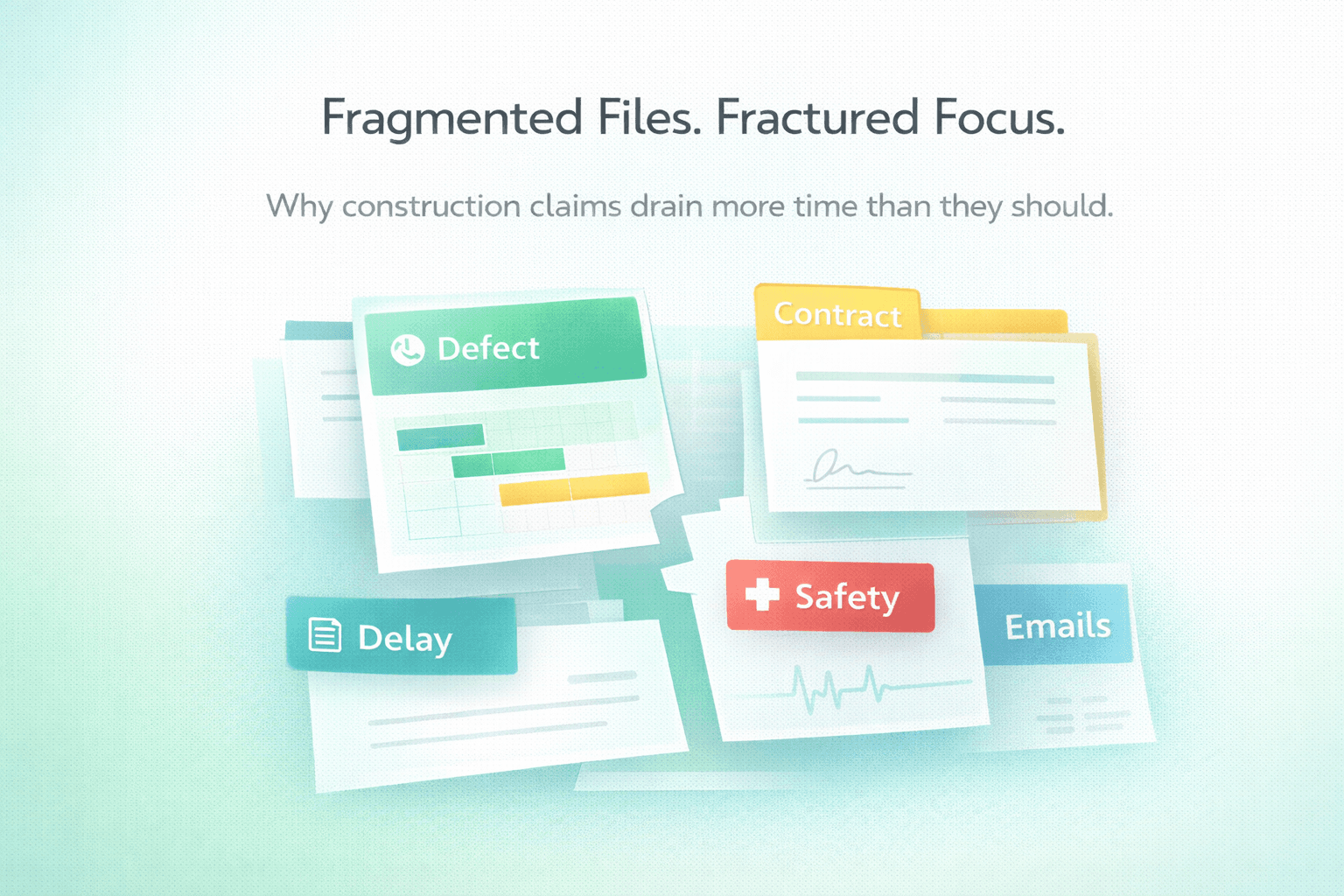
Why does context collapse? A few reasons:
- Information is scattered: The relevant details for each claim type live in different documents. You might have to dig into the schedule program for the delay claim, scour drawings and specs for the defect claim, check the contract General Conditions for breach issues, review correspondence emails for the payment dispute, and consult safety reports/OSHA logs for the injury claim. These are all in different folders or systems. Without a centralized system, critical details are easily lost or overlooked .
- Different rules apply: Each claim type invokes different clauses and evidence. The delay issue requires analyzing notice of delay letters and critical path impacts, whereas the defect issue requires inspection reports and maybe code standards. It’s mentally taxing to switch between the “rules of the game” for each topic.
- Rapid switching: In a single day, you might bounce from a delay claim meeting to a quality walk for defects, then a phone call about a lien release, then back to updating a claim register. Every switch means you have to get your brain back into that claim’s unique details. It’s not just multitasking – it’s re-loading a whole set of context each time.
- Re-reading and double-checking: Because of the above, people spend a lot of time simply finding and reconciling information. For example, each time the delay claim comes up, you may reopen the contract to re-read the liquidated damages clause or the notice provisions, because you were knee-deep in something else and lost the thread. Or you might repeatedly cross-check the latest schedule update to recall which activities were on the critical path.
- Version control and communication gaps: Multiple team members handling overlapping issues can lead to fragmented records. Maybe one person has the latest email from the owner on the defect issue, while another is updating the schedule analysis. Without a single source of truth, everyone is piecing together the puzzle repeatedly from scratch.
The result of this context switching is familiar to many construction professionals: even experienced teams find themselves spending more time searching for information and rebuilding context than actually analyzing risk or crafting a solid claim response. It’s exhausting and inefficient. When each claim type is siloed in its own paper trail, the team’s brainpower gets drained on administrative hunting rather than strategic thinking. This is where modern tools can step in to help.
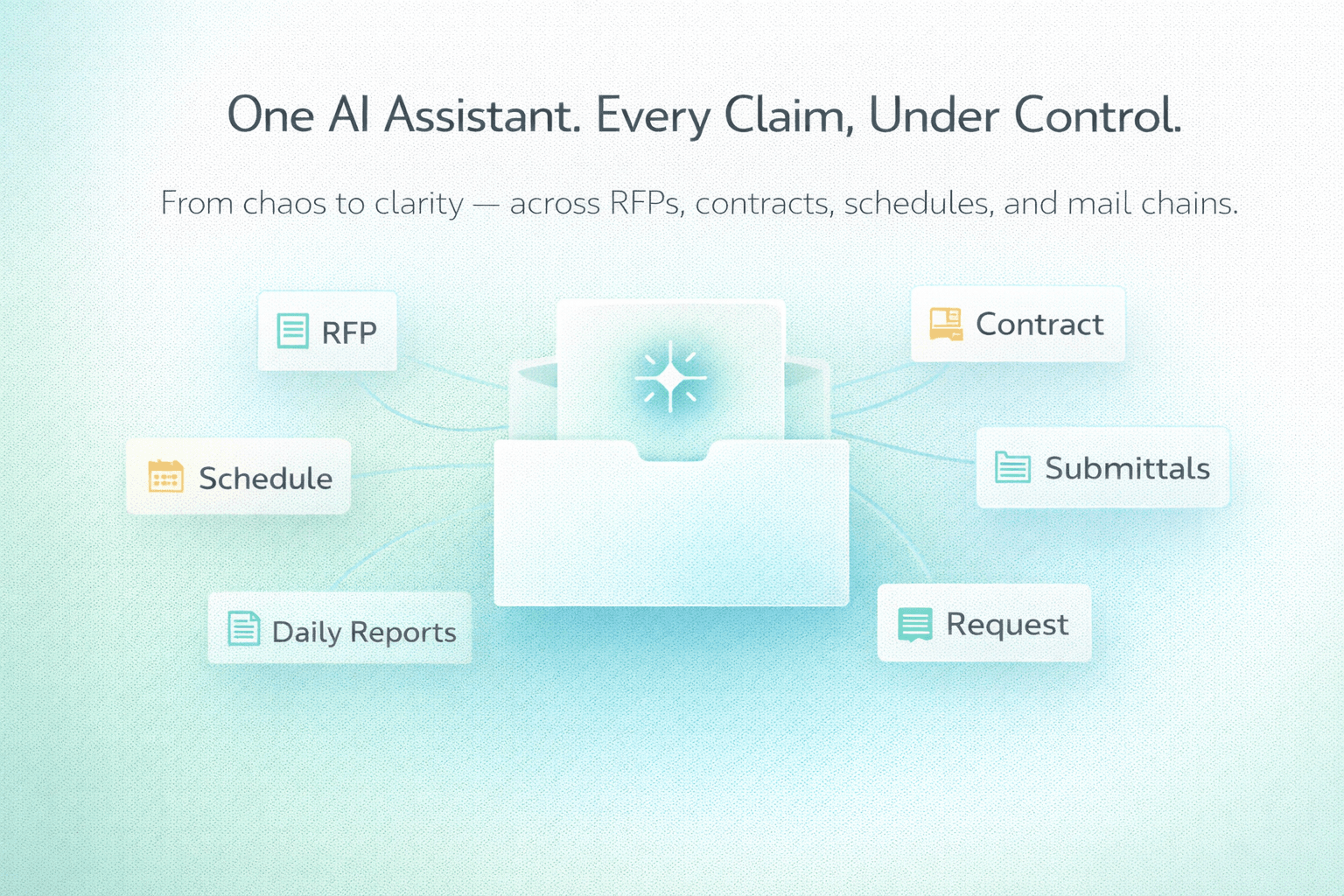
How can AI Construction Claim Management Tool Help
Managing the chaos of multiple concurrent claims is exactly the kind of information-heavy work AI is built for. A good AI Construction Claim Management Tool acts like an always-on claims assistant reading your RFP package, contract, submittals, schedules, daily reports, and email chains and keeping each claim organized with the right context.
Here’s how it helps in practice especially when you need to respond to owners, consultants, agencies, or other authorities:
1) Pulls the full story from email chains and RFP packages
Most claim “proof” is buried in long threads: RFIs, owner instructions, meeting minutes, approvals, late responses, revised drawings, and “as discussed” emails. AI can ingest those mail chains and the full RFP/contract package, then surface:
- Who said what, when (timeline of key communications)
- The relevant clause that applies (notice, EOT, compensation, warranty, etc.)
- The supporting attachments (revised drawings, site instructions, test reports)
So instead of re-reading 200 emails to rebuild context, you get the narrative instantly.
2) Centralized “Claim Threads” (one claim = one structured case file)
AI can keep each claim type (delay, defect, breach, lien, injury) as a distinct “case,” with:
- A running timeline of events
- Tagged documents and correspondence
- Linked schedule snapshots (for delay) or QA/QC records (for defects)
- Status, responsibilities, and next actions
This prevents the classic mix-up where multiple claims get tangled inside one folder or one email chain.
3) Clause-linked obligations (so you don’t miss notices or required steps)
Once a claim is identified, the system can pin the exact contract/RFP obligations that control it like:
- Notice requirements and time bars
- Documentation requirements
- Entitlement triggers and exclusions
- Required format for submissions
That means fewer “we missed the notice window” problems, and fewer back-and-forth rejections due to missing clause references.
4) Evidence mapping that strengthens your submission
AI can connect evidence to each claim point so your response is not just a story it’s a traceable, clause-backed package:
- Emails → linked to delay events or approvals
- Daily reports → linked to manpower/equipment impacts
- NCRs/test reports → linked to defect allegations
- Meeting minutes → linked to owner directives
When you’re responding to an owner/engineer/authority, this “evidence-to-assertion” mapping makes your submission easier to review and harder to dismiss.
5) Drafts cleaner, faster responses to owners, consultants, and authorities
This is the practical win: AI can produce a first-draft response that is:
- Structured the way reviewers expect (issue → clause → facts → evidence → request)
- Consistent in tone and terminology
- Referenced properly (document names, dates, clause numbers)
Your team still reviews and signs off but the time-consuming “start from blank page” work disappears.
6) Improves the odds of getting claims approved (by reducing preventable errors)
AI can’t “guarantee approval,” but it can materially improve outcomes by removing common failure points:
- Missing notices
- Weak documentation trails
- Inconsistent narratives across teams
- Incorrect clause citations
- Gaps between schedule impacts and correspondence
In other words: fewer avoidable rejections, faster clarifications, and a more defensible record when the reviewer challenges your entitlement.
---
Conclusion: Navigating Construction Claims Effectively
In today’s environment, one contract or RFP can trigger multiple claims at once. It’s more important than ever to have systems (processes and tools) that preserve context and prevent information overload.
Here Construction Claims AI can pull context from mail chains and RFP packages, organizing evidence, and drafting structured responses. An AI Construction Claim Management Tool lets your team spend more time on strategy and negotiation, and less time on searching, re-reading, and rebuilding context every time a claim pops up.
FAQs
Sign Up for more like this
By submitting this form, you agree to our Privacy Policy and consent to receiving updates from ContraVault.
Comments0