Federal Acquisition Regulation (FAR) Part 15: Contracting by Negotiation (RFP Rulebook)

FAR Part 15 governs U.S. federal RFPs and negotiated awards—how proposals are evaluated, how tradeoffs vs LPTA work, and how clarifications, discussions, and pricing analysis shape the final selection.

Federal Acquisition Regulation (FAR) Part 15: Contracting by Negotiation (RFP Rulebook)

FAR Part 15 is the heart of most federal RFP-style procurements. When an agency wants to evaluate offers based on more than just lowest price—think technical approach, staffing, schedule confidence, past performance, risk posture, and management plan—Part 15 is typically the framework used. For bid managers, proposal teams, and capture leads, Part 15 is the “how the government decides” playbook: it governs how proposals are evaluated, when the government can talk to offerors, how tradeoffs are justified, and how pricing is analyzed before award.

What FAR Part 15 covers in plain English

Part 15 primarily covers competitive negotiated contracting, including:

  • Source selection rules (how the government compares and ranks proposals)
  • Best value decision-making (tradeoffs vs lowest price technically acceptable)
  • Proposal evaluation concepts and fairness expectations
  • Exchanges with offerors after proposals are received (clarifications, communications, discussions)
  • Contract pricing and proposal analysis (price analysis, cost analysis, subcontract pricing considerations, profit)
  • Negotiation documentation (what contracting officers must document in the file)
  • Unsolicited proposals (how agencies may handle proposals not requested in a solicitation)

In practical terms: Part 15 is why two “compliant” bids can receive different outcomes—because Part 15 allows agencies to choose the offer that represents the best overall value, not just the lowest number.

FAR Part 15’s most important concept: the Best Value Continuum

Part 15 introduces the best value continuum, which includes two common selection approaches:

Tradeoff (Best Value Tradeoff)

A tradeoff process allows the government to award to an offeror that is not the lowest priced when the higher-rated proposal offers benefits that justify paying more. This is where narrative and proof matter: risk reduction, execution plan credibility, staffing quality, schedule realism, and past performance relevance can legitimately outweigh a price delta.

LPTA (Lowest Price Technically Acceptable)

LPTA is used when the government expects best value from selecting the lowest-priced proposal that meets minimum requirements. No tradeoffs are permitted. If the requirement is clearly defined and performance risk is low, LPTA can be a faster method. For proposal teams, this means compliance discipline and avoiding “unacceptable” findings are everything—because price becomes the primary differentiator after acceptability.

Proposal evaluation and “what you say must match how they score”

Part 15 requires that evaluation factors and significant subfactors (and their relative importance) be clearly stated in the solicitation when using tradeoffs. This creates a simple but powerful proposal rule: organize your response exactly the way the government evaluates. If the evaluation factors are Technical, Past Performance, and Price—your proposal structure, headings, and proof should mirror that logic. A strong Part 15 proposal is one where reviewers can quickly connect your claims to the evaluation factor language with minimal interpretation.

Exchanges with offerors: clarifications vs communications vs discussions

One of the most misunderstood areas in Part 15 is what the government can ask after proposals are submitted. Part 15 outlines a spectrum of exchanges:

  • Clarifications: limited exchanges when award without discussions is contemplated (usually minor points, not proposal rewrites).
  • Communications: exchanges that may occur before establishing the competitive range, often to address certain issues without opening full discussions.
  • Discussions: negotiated interactions after the competitive range is established, typically involving addressing deficiencies and significant weaknesses and giving offerors a fair chance to revise.

For bidders, the takeaway is operational: treat every post-submission question as a controlled negotiation moment. Have a pre-built internal workflow for rapid responses, version control, and traceability—especially when addenda or shifting requirements appear.

Part 15 pricing and “fair and reasonable” isn’t optional

Part 15’s contract pricing rules focus heavily on ensuring the final agreed-to price is fair and reasonable. Contracting officers can use multiple analytical techniques, depending on the acquisition—ranging from straightforward price comparisons to deeper cost analysis approaches when appropriate. Subcontract pricing, profit considerations, and documentation expectations all sit under this umbrella. For contractors, this changes how you should price and justify:

  • Keep assumptions explicit and consistent across technical and commercial volumes
  • Back up major cost drivers with logic that can withstand scrutiny
  • Ensure subcontractor quotes and allocations are defensible and current
  • Avoid hidden risk-loading that contradicts your “low risk” technical narrative

Part 15 proposal playbook: how bid teams should operate

Use this as a field-tested approach to stay aligned with Part 15 realities:

1) Build a Compliance-to-Evaluation Map (before drafting)

Create a single master tracker that includes:

  • Mandatory requirements (every “shall” and submission instruction)
  • Evaluation factors and subfactors (exact phrasing from the RFP)
  • Your planned proof artifacts (past performance references, staffing resumes, plans, schedules)

2) Write for evaluator speed

Part 15 awards are influenced by how quickly evaluators can validate strength. Use:

  • Short, verb-led headings aligned to subfactors
  • Evidence-first writing (what you did, what it achieved, why it reduces risk)
  • Clear cross-references between approach, staffing, and schedule

3) Be “discussion-ready” from day one

Maintain an internal log of:

  • Potential ambiguities in the RFP
  • Assumptions you used
  • Pricing sensitivities and alternates
  • What you can concede or clarify without damaging compliance

4) Make pricing match the story

If your technical volume says “low risk, proven approach,” your price volume can’t look like a speculative bet. Part 15 pricing scrutiny punishes misalignment.

FAR Part 15 Checklist (copy-paste)

  • Confirm whether the RFP is tradeoff or LPTA and tailor strategy accordingly
  • Mirror the evaluation factors in proposal structure and headings
  • Create a master compliance matrix and lock submission requirements early
  • Prepare a clarification/discussion response workflow (roles, SLAs, version control)
  • Build a pricing rationale pack that supports “fair and reasonable” analysis
  • Validate subcontractor pricing, scope alignment, and flowdowns
  • Document assumptions and ensure they are consistent across volumes
  • Plan for addenda: change log, impact analysis, and quick re-validation of compliance

Sources

Bidding on public RFPs?

Get our RFP Survival Kit with a handy RFP glossary, ready-to-use templates, and practical checklists to cut through jargon, spot risks early, and win more bids.

Related Resources

No related resources found.

Turn RFP Knowledge into Winning Bids

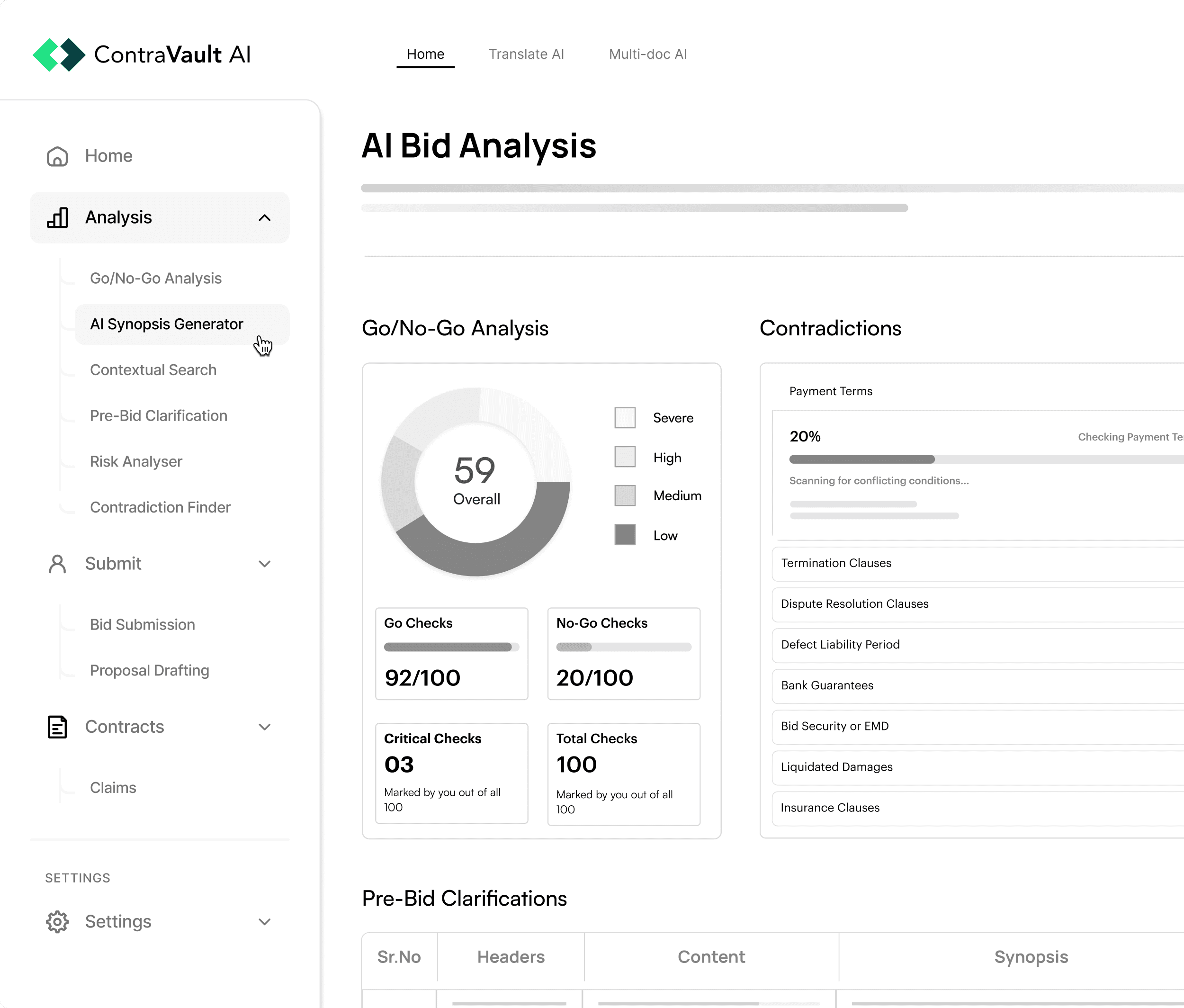
ContraVault AI reads your full RFP set, finds every requirement, flags risks and contradictions, and drafts compliant responses – so you move from definitions to decisions in minutes, not days.

AI Bid Analysis

Why Do Proposal Teams Rely on Us?

ContraVault AI has processed over $500M in project value, analyzed 200K+ RFPs, parsed 10M+ pages, and drafted 25K+ pre-bid clarifications.

Instills Confidence and Consistency in the RFQ Process

The confidence it provides throughout the RFQ process. Whereas the QC of the data input from all various departments is highly detailed and consistent. It removes any second guessing.

Donald B. - Small-Business (50 or fewer emp.)

Empowers Competitive Bidding with Precision

At Olivaw, we receive around 200 RFPs annually in Impact, People, Energy and Healthcare sectors. ContraVault AI not only helps us with clear Go/No Go analysis, it provides me with evidence on which risks we can manage as an organisation and which ones are out of scope for us.

Arjun D. - Managing Director, CEO

Outstanding Experience from Synopsis to Forms AI

ContraVault AI makes managing Synopsis, Pre-Bid, and tender documentation workflows incredibly smooth. It intelligently organizes and summarizes large security and compliance documents, saving huge amounts of time during review cycles. The automated insights, smart comparison features, and clean dashboard make collaboration easy and eliminate manual effort.

Karan P. - Technical Director

Streamlining Human-Driven Processes with AI

ContraVault AI is doing a great job in the contracts and legal space by using AI to reduce time and cost. It is really helping streamline a lot of processes which used to be severely human-driven.

Mr. Som Mandal - Managing Partner at Fox Mandal

Faster and More Accurate Tendering

We have introduced ContraVault AI, the AI-based software in our organization. We have found the same is easy to use and its unique features helping us to make our tendering process faster and more accurate.

Mr. Arun Singhania - CFO at Paharpur Cooling Towers

A Paradigm Change in Contract Management

ContraVault AI, a great software for legal contracts management through artificial intelligence, could bring in a paradigm change in creating, reviewing, and validating legal contracts. I can definitely recommend this product for all finance and legal professionals.

Mr. Partha Hor - VP Finance at Lenze India

Turns RFP Reading into Instant Clarity

For us, the combination of Synopsis + Contextual Search is the real win - within minutes, we can get a structured summary and then jump straight to the exact clauses (technical or commercial) with the right context. It’s shifting our workflow from “open PDFs and start reading” to “start in ContraVault AI,” which reduces rework and lowers the risk of misinterpretation. The team is quite friendly and approachable Earlier, teams spent days reading, searching, and compiling information, and interpretations could vary depending on who read which clause. With ContraVault AI, we can generate a structured synopsis in minutes and use contextual search to land on the exact commercial or technical clause with the surrounding context. That reduces rework, lowers the risk of misinterpretation, and helps the whole team align faster. The benefit is simple: we move from “opening PDFs and trying to figure it out” to “starting with clarity,” which speeds up internal reviews and improves confidence in what we’re responding to.

Max Mortezapour - Consultant, Crossarrows

Lightning-Fast Search with AI-Powered Mentions and Synopses

ContraVault AI's contextual search function makes life easy. The search activity takes much less time than if done manually. AI jolts down all the mentions of related topic from entire document spanning thousands of pages and provide a synopsis on the same as well.

Kalyan M. - Senior Manager - PCTL

Why Do Proposal Teams Rely on Us?

$500M+
Project Value Processed
200K+
RFPs Analyzed
10M+
Pages Parsed & Analysed
25K+
Pre-Bid Clarifications Drafted

"Instills Confidence and Consistency in the RFQ Process"

The confidence it provides throughout the RFQ process. Whereas the QC of the data input from all various departments is highly detailed and consistent. It removes any second guessing.

Donald B.

Donald B.

Small-Business (50 or fewer emp.)

G2 Review

"Empowers Competitive Bidding with Precision"

At Olivaw, we receive around 200 RFPs annually in Impact, People, Energy and Healthcare sectors. ContraVault AI not only helps us with clear Go/No Go analysis, it provides me with evidence on which risks we can manage as an organisation and which ones are out of scope for us.

Arjun D.

Arjun D.

Managing Director, CEO

G2 Review

"Outstanding Experience from Synopsis to Forms AI"

ContraVault AI makes managing Synopsis, Pre-Bid, and tender documentation workflows incredibly smooth. It intelligently organizes and summarizes large security and compliance documents, saving huge amounts of time during review cycles. The automated insights, smart comparison features, and clean dashboard make collaboration easy and eliminate manual effort.

Karan P.

Karan P.

Technical Director

G2 Review

"Streamlining Human-Driven Processes with AI"

ContraVault AI is doing a great job in the contracts and legal space by using AI to reduce time and cost. It is really helping streamline a lot of processes which used to be severely human-driven.

Mr. Som Mandal

Mr. Som Mandal

Managing Partner at Fox Mandal

"Faster and More Accurate Tendering"

We have introduced ContraVault AI, the AI-based software in our organization. We have found the same is easy to use and its unique features helping us to make our tendering process faster and more accurate.

Mr. Arun Singhania

Mr. Arun Singhania

CFO at Paharpur Cooling Towers

"A Paradigm Change in Contract Management"

ContraVault AI, a great software for legal contracts management through artificial intelligence, could bring in a paradigm change in creating, reviewing, and validating legal contracts. I can definitely recommend this product for all finance and legal professionals.

Mr. Partha Hor

Mr. Partha Hor

VP Finance at Lenze India

"Turns RFP Reading into Instant Clarity"

For us, the combination of Synopsis + Contextual Search is the real win - within minutes, we can get a structured summary and then jump straight to the exact clauses (technical or commercial) with the right context. It’s shifting our workflow from “open PDFs and start reading” to “start in ContraVault AI,” which reduces rework and lowers the risk of misinterpretation. The team is quite friendly and approachable Earlier, teams spent days reading, searching, and compiling information, and interpretations could vary depending on who read which clause. With ContraVault AI, we can generate a structured synopsis in minutes and use contextual search to land on the exact commercial or technical clause with the surrounding context. That reduces rework, lowers the risk of misinterpretation, and helps the whole team align faster. The benefit is simple: we move from “opening PDFs and trying to figure it out” to “starting with clarity,” which speeds up internal reviews and improves confidence in what we’re responding to.

Max Mortezapour

Max Mortezapour

Consultant, Crossarrows

"Lightning-Fast Search with AI-Powered Mentions and Synopses"

ContraVault AI's contextual search function makes life easy. The search activity takes much less time than if done manually. AI jolts down all the mentions of related topic from entire document spanning thousands of pages and provide a synopsis on the same as well.

Kalyan M.

Kalyan M.

Senior Manager - PCTL

Certification & Compliance

Your RFP data stays private.

ContraVault AI is built for sensitive bid documents-with access controls, encryption, and auditability so teams can work fast without exposing confidential information.

ISO 42001
ISO 27018 2019
ISO 27017
ISO 9001 2015
AICPA SOC 2
ISO 27001 2022
EU GDPR Compliant

Turn complexity into clarity

One place to review, search, and draft—so you don't lose days in PDFs, email threads, and contradictory notes.

Request Demo