The Context
On January 24, senior bid and proposal professionals convened for a closed-door RFP Roundtable to discuss a topic rarely addressed openly in procurement: the biases and hidden influences that shape bid outcomes.
This was not a webinar or panel. It was a practitioner-only working session designed to surface what structured scorecards often miss — how trust, execution history, institutional memory, and risk perception quietly guide decisions.
Across industries and geographies, one reality emerged clearly: RFPs appear objective. In practice, they operate as systems of trust and risk management.
Who Was in the Room?
Senior bid leaders and commercial practitioners spanning nuclear energy, infrastructure, healthcare, international development, construction, and technology across Europe, the United States, Africa, and Asia.
5 Key Findings
RFPs rarely start with the RFP.
Execution confidence quietly outranks technical merit in most high-stakes bids.
Bias is largely structural, embedded in risk controls-not personal preference.
Financial resilience increasingly matters more than pricing.
AI accelerates analysis, but relationships still determine trust.
Top 3 Takeaways
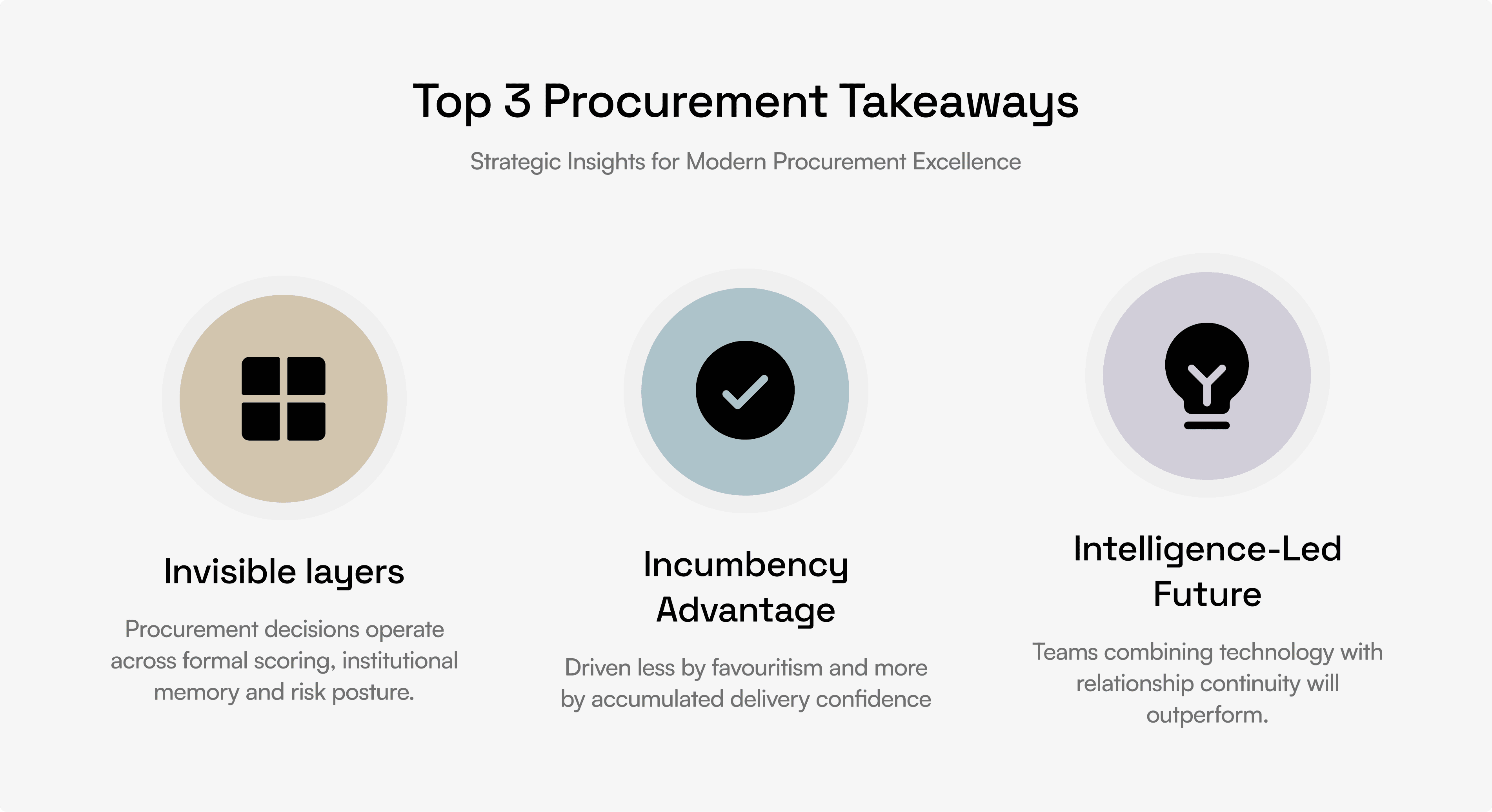
Procurement decisions operate across invisible layers: formal scoring, institutional memory, and risk posture.
Incumbency advantage is driven less by favoritism and more by accumulated delivery confidence.
The future of RFPs is intelligence-led: teams that combine technology with relationship continuity will outperform.
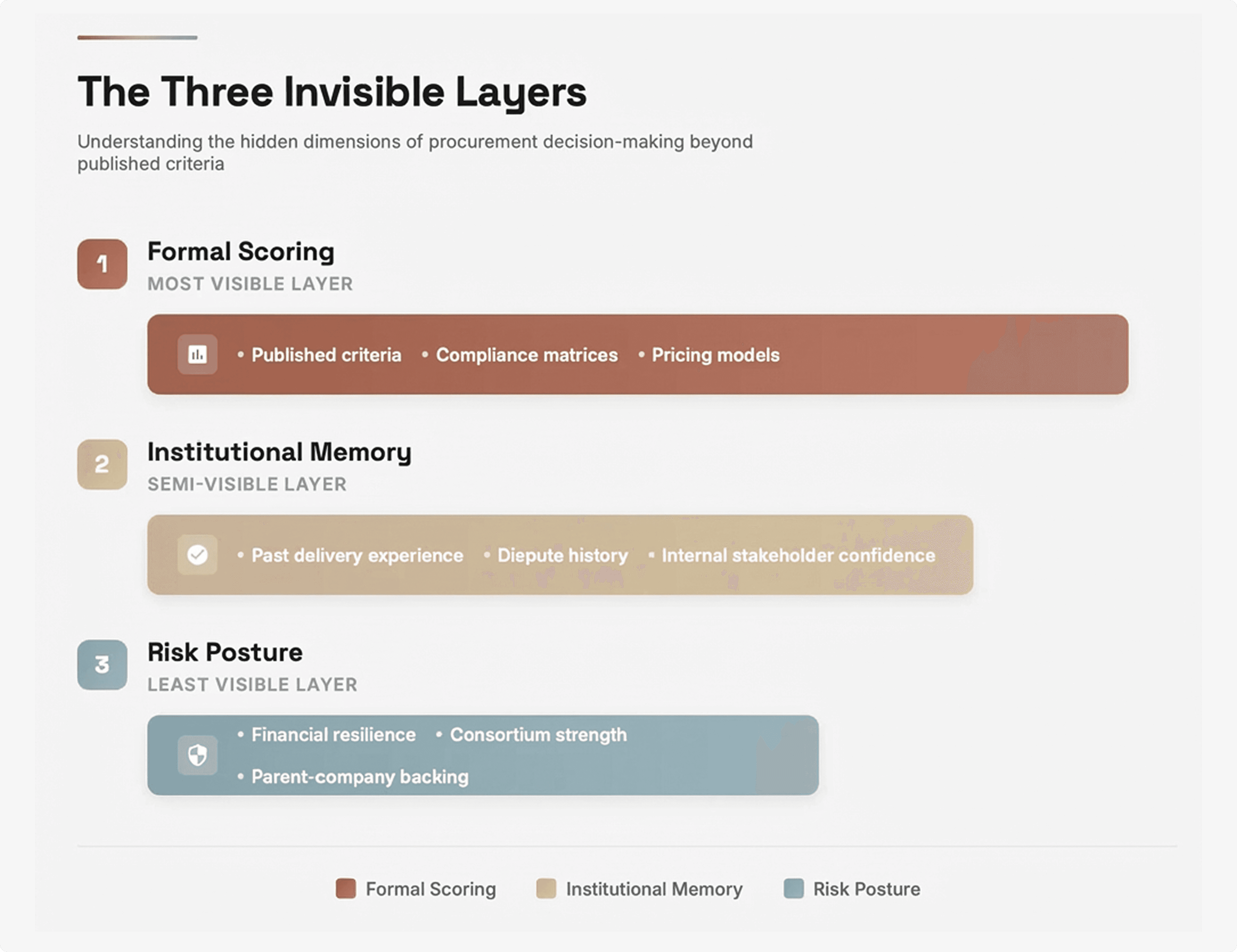
The Three Invisible Layers
From the discussion emerged a consistent framework:
- Formal Scoring - Published criteria, compliance matrices, pricing models.
- Institutional Memory - Past delivery experience, dispute history, internal stakeholder confidence.
- Risk Posture - Financial resilience, consortium strength, parent-company backing.
Most organizations optimize for Layer 1.
Winning bids are decided primarily in Layers 2 and 3.
This explains why technically compliant proposals still lose-and why incumbents often outperform new entrants.
RFPs Rarely Start With the RFP
One of the strongest themes was that procurement begins long before documents are issued.
In long-cycle industries like nuclear and infrastructure, engagement often spans months-or years.
“Trust doesn't start when you receive the RFP. Sometimes it starts years earlier. Clients need to know they can rely on you technically, financially, and operationally.”
- Massimo Giorgi, Bid Manager, Nuclear Sector
Early technical alignment, informal conversations, and consistent presence shape expectations well before evaluation criteria are finalized.
“As a new entrant, your competition isn't the big companies yet. First, you're competing against your own readiness-your research, your resources, your team, and whether buyers even know you exist.”
- Priscilla Osaro
Proposals formalize relationships. They rarely create them.
The Contrarian Truth: Execution Confidence Beats Technical Merit
Every RFP claims objectivity. Yet execution history routinely reshapes how criteria are applied.
“If a client has executed successfully with you on time, within cost, without disputes-that relationship carries forward. Even small deviations get discussed instead of penalized.”
- Kaustav
“The RFP process looks structured, but it's a chess game built on past performance and trust.”
- Don Benson
This is not corruption. It is institutional memory.
Buyers prioritize delivery certainty over theoretical excellence.
In high-stakes environments, execution confidence quietly outranks technical merit.
Structural Bias Is Built Into Risk Controls
Most bias is not human. It is procedural.
Revenue thresholds, experience requirements, documentation volume, and compliance gates systematically favor incumbents.
Markets are slowly adapting through:
- Performance bonds
- Bank guarantees
- Joint ventures
“Earlier, tenders demanded exact replicas of past projects. Now similarity is broader, and performance guarantees replace massive revenue thresholds. This allows new entrants while still protecting delivery.”
- Kaustav
These shifts open doors-but transfer financial risk to bidders.
Modern RFPs are evolving from vendor selection tools into risk distribution frameworks.
Transparency Stops at the Score
While digital procurement portals improved access, feedback remains shallow.
“We don't just want a percentage score. We want to know what actually mattered. Where did we miss the buyer's real priorities?”
- Priscilla Osaro
Most feedback explains outcomes, not decisions.
Without actionable insight, bidders repeat mistakes-and competition stagnates.
True transparency begins after the award.
Institutional Knowledge Is the Hidden Advantage
Organizations accumulate years of bidding intelligence-what failed, what worked, which clauses created disputes.
Yet most of this lives in people, not systems.
“Thousands of bidding decisions sit inside people's heads. When they leave, that experience leaves too.”
- Isha Juneja
Teams then relearn lessons under deadline pressure.
Technology's emerging role is not automation-it is preserving organizational memory.
AI's Real Role: From Productivity to Accountability
AI already supports document analysis and requirement extraction.
But guests emphasized a deeper opportunity: surfacing historical patterns at scale.
“AI can analyze thousands of past projects in seconds. Humans still build trust but technology should handle the heavy research so teams can focus on strategy and relationships.”
- Isha Juneja
“Smaller vendors are no longer just competing with peers. They're competing with platforms.”
- Hahz
This raises new questions around market access, fairness, and governance.
Market Pressure Is Reshaping Competition
Shrinking funding pools in public-sector and development projects are reducing tender volumes.
“There's simply less funding. Fewer tenders. That makes competition sharper and risk tolerance lower.”
- Priscilla Osaro
As uncertainty rises, buyers become conservative-reinforcing incumbency advantage.
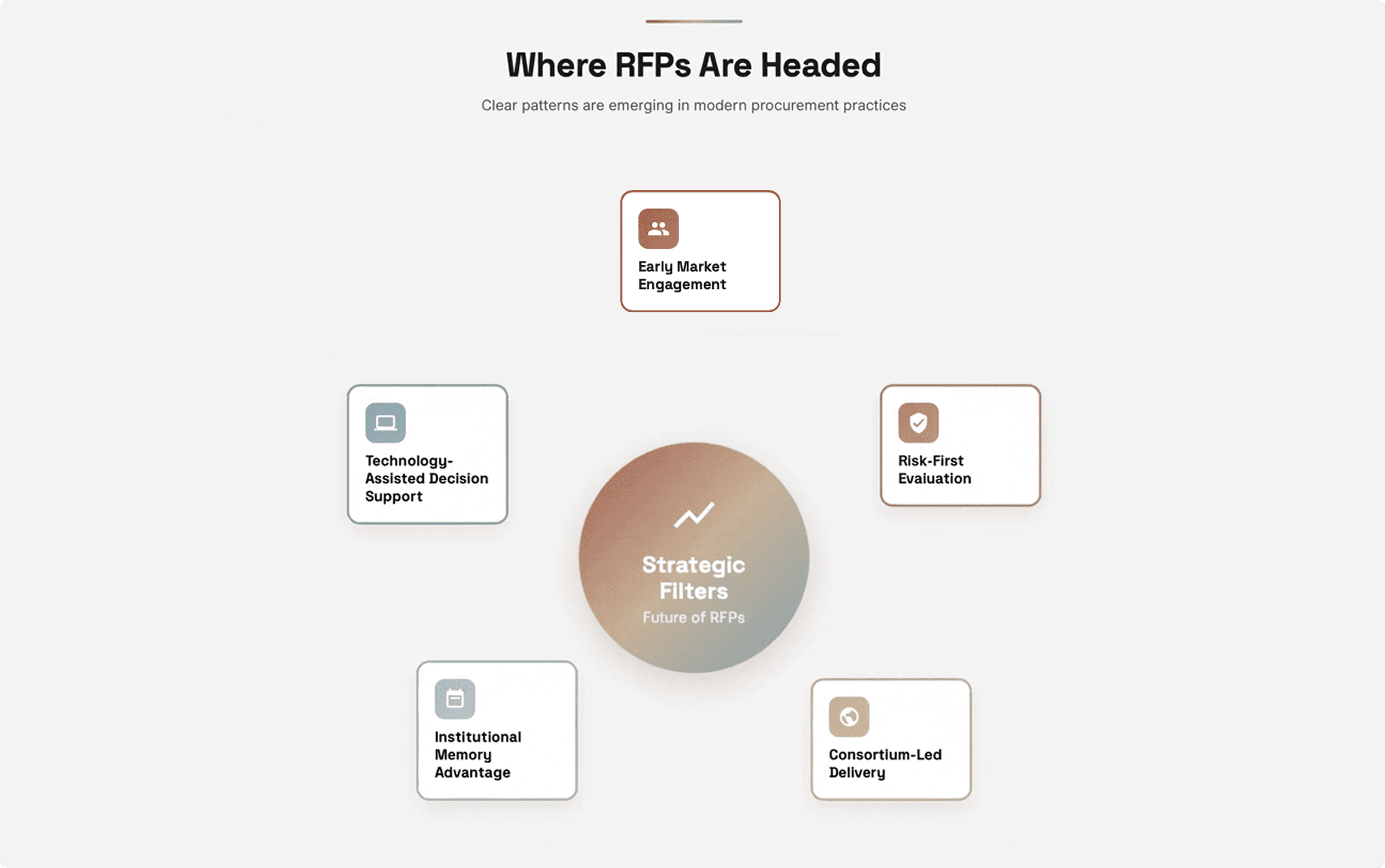
Where RFPs Are Headed
Clear patterns are emerging:
- Early market engagement before tenders
- Risk-first evaluation over lowest price
- Consortium-led delivery models
- Institutional memory advantage
- Technology-assisted decision support
RFPs are no longer administrative workflows.
They are strategic filters.
Practical Takeaways
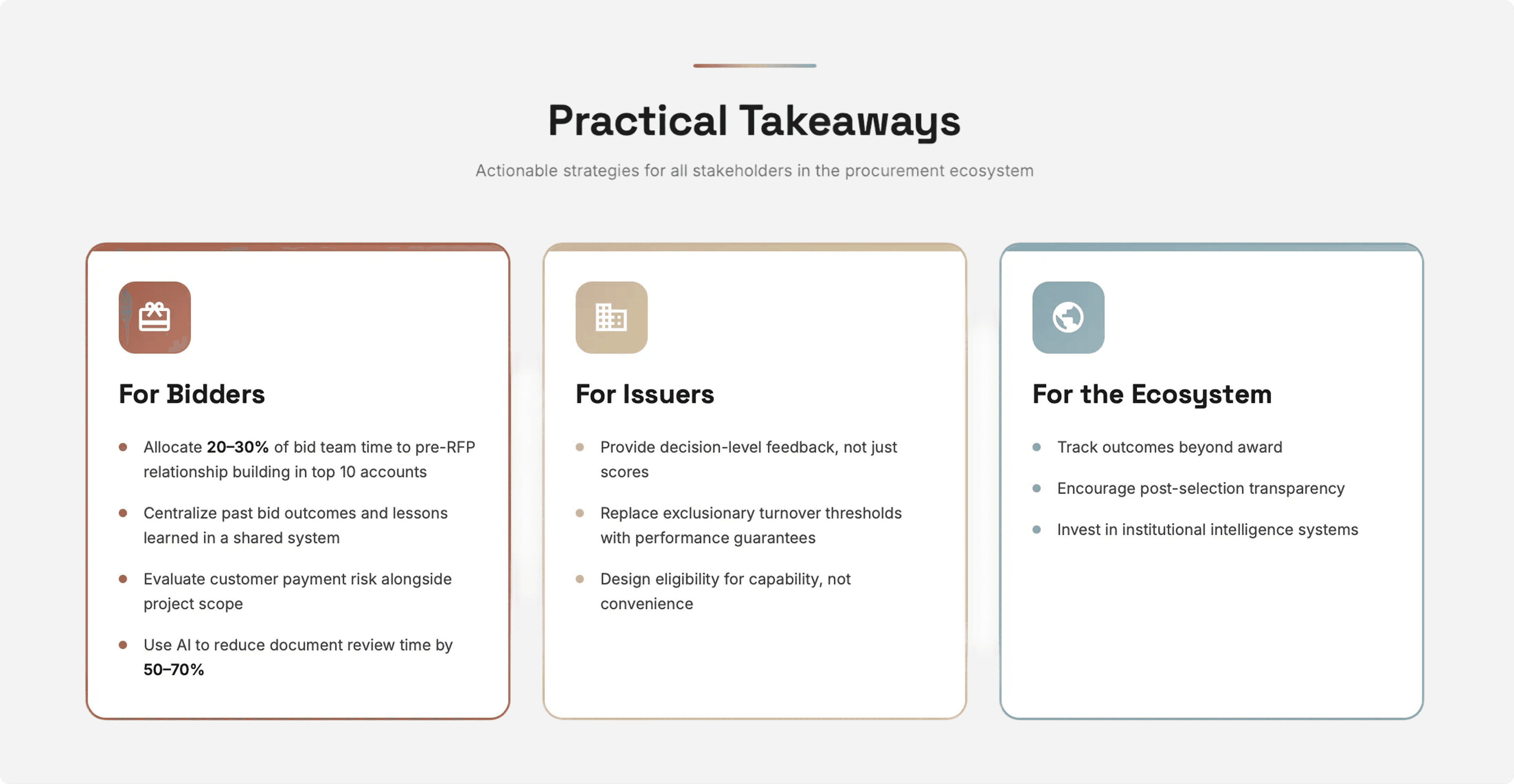
For Bidders
- Allocate 20-30% of bid team time to pre-RFP relationship building in top 10 accounts
- Centralize past bid outcomes and lessons learned in a shared system
- Evaluate customer payment risk alongside project scope
- Use AI to reduce document review time by 50-70%
For Issuers
- Provide decision-level feedback, not just scores
- Replace exclusionary turnover thresholds with performance guarantees
- Design eligibility for capability, not convenience
For the Ecosystem
- Track outcomes beyond award
- Encourage post-selection transparency
- Invest in institutional intelligence systems
From the discussion emerged a consistent framework:
The Outlook
Procurement is moving from document-centric workflows toward intelligence-led decision systems.
The next generation of RFPs will reward teams that combine:
- Relationship continuity
- Traceable experience
- Risk awareness
- Institutional memory
- Technology-supported insight
Bias will not disappear overnight-but it can become visible, measurable, and manageable.
What's Next
This session marked the beginning of ongoing global RFP Roundtables.
Upcoming topics include:
- Bias mitigation frameworks
- AI-assisted evaluation models
- Risk-first procurement design
- Transparency after award